Medieval manuscripts and paleography were what this blog was originally about, but this has got a bit swamped lately with some other themes. My website Medieval Writing still seems to be used, and I get some interesting feedback from users, despite the fact that it is becoming technologically aged. Here are some of the posts that people have found interesting.
Web Sites and Medieval Manuscripts Something I thought in 2006. Wonder if it still holds good.
Medieval Manuscripts on the Move Digitisation of manuscript collections has come a long way since 2007.
Classification of Scripts Yes, I still have radical ratbag views about script classification in paleography.
Manuscripts and Information Control A whole bunch of people have been devoting their efforts to medieval marginalia since I wrote this.
Why Paleography Sucks Never do irony on the web.
Disappearing Paleography From the days when you got blog post comments from interested participants, not just snake oil salesmen and spivs.
Writing and Remembering One of those random thought bubbles I should try to retrieve some time.
Not That Voynich Manuscript Again NEVER mention the V****** M********* in any forum on the internet.
Horrible Old Handwriting Merovingian minuscule in this case. It's not all about the pretty stuff.
Gothic Book Hands Gothic Book Hands. Pointer to section on Medieval Writing website.
Special English Characters Another pointer.
1066 and All That Dianne has bitch attack about historical periodisation, and another pointer to post Conquest Old English writing.
Of Tennis Balls and Mulberry Trees Pointer to script example of Gothic cursive from a very strange manuscript fragment.
John Paston's Books Pointer to paleography exercise on John Paston's book list in the British Library.
History of the Familiar Pointer to history of humanistic minuscule.
It's Personal Wee note on a medieval autograph.
Dirty Medieval Books Pointer to interesting work by Kathryn Rudy. For some reason a lot of people have clicked on this. Hope they were not disappointed.
Monastic Pressmarks Monastic pressmarks. Pointer to section of website on them.
Glossed Bible Pointer to a bit of interesting medieval detritus.
Little French Things Pointer to script sample of 14th century French cursive.
You Want Vinegar With Your Oak Galls? My most viewed blog post ever. If any subject arouses passion and commitment it is the correct formulation for iron gall ink.
The Writing of the Illiterate Lombards More irony, Lombardic minuscule, and more iron gall ink.
Shoes and Ships and Sealing Wax Pointer to website section on seals.
Medieval Recycling Pointer to script sample of French cursive on a document recycled into a book wrapper.
Boring Jobs and Bizarre Coincidences Hufnagelschrift.
Medieval Documents Medieval documents. Pointer to website section on dealing with them.
What Not To Do With Your Manuscripts Pointer to website section on manuscript conservation.
Manuscripts and Naked Hands The great white gloves controversy.
Medieval Digimania The ever changing status of digitised medieval manuscripts on the web.
When Did Latin Become Dead? Pointer to website sample of scramboozled 16th century English and Latin.
Ferocity of Iron Gall Ink That stuff again, and how it consumes itself.
Vale Notice of passing of Malcolm Parkes.
Ever Wonder What Paleographers Do? The Getty knows.
Working Script for (Somewhat) Ordinary Books French batarde.
Blockbuster Epic Resource for Paleographers and Historians Dictionary of Medieval Latin from English Sources. Think it's now up on the web as well.
Colophons and Marginalia and All That Colophon and gloss to the Lindisfarne Gospels.
Irish Gospels Insular minuscule.
Bored with Gothic? Try This. Beneventan minuscule.
Sweet Caroline Caroline minuscule.
Protogothic and Choking Lions Protogothic.
Beasties from the Bestiary Gothic textura, with animals.
It's Gothic Jim, But Not As We Know It That totally weirdshit script from the Luttrell Psalter.
Magdalen in Blue Gothic rotunda.
Hoccleve on Chaucer Gothic bastarda
Flyleaf Friday. Or When is a Manuscript Finished? On adding prayers to books of hours.
Notarial Signs Notarial signs.
Medieval Graffiti and Medieval Marginalia Ponderings on scratchings in the margins of life.
Cutting Up Manuscripts Why you shouldn't cut up manuscripts, and why people did.
A companion to the website Medieval Writing, concerning itself with medieval handwriting and its cultural setting, now expanded to encompass aspects of medieval heritage and material culture. Tweeting as Hipster Bookfairy . Gradually putting medieval photos on Flickr
Showing posts with label handwriting. Show all posts
Saturday, March 12, 2016
Friday, December 06, 2013
Gazumped!
It had to happen. Some clever person out there has put medieval paleography exercises on to something more modern than ye olde PC. If you want to do your paleography exercises on your iPhone or iPad, there is now an app to do it. Check it out here.
I'll just crawl back into my dinosaur cave, unless there are still a few old fogies out there whose eyesight is not amenable to medieval handwriting on a small screen. Congrats you guys at Leeds University.
Addendum: also available for Android from Google Play. Will do a review if I can get my head away from my phone for long enough.
Addendum again: sorry, no can do. Even my phone is too prehistoric. Slow down world!
I'll just crawl back into my dinosaur cave, unless there are still a few old fogies out there whose eyesight is not amenable to medieval handwriting on a small screen. Congrats you guys at Leeds University.
Addendum: also available for Android from Google Play. Will do a review if I can get my head away from my phone for long enough.
Addendum again: sorry, no can do. Even my phone is too prehistoric. Slow down world!
Saturday, August 24, 2013
Ever Wondered What Paleographers Do?
Or for that matter why they do it. Here is a really nice summary, with beautiful eye candy manuscript pics.
Sunday, July 21, 2013
When Did Latin Become Dead?
It is commonly asserted that Latin was a dead language in the middle ages. Well, it wasn't. They simplified and changed the grammar, introduced a great deal of new vocabulary and used it for assorted daily purposes, especially in the church and the legal professions. However, by the 16th century it was getting decidedly wobbly on its feet, but English as a written language was far from standardised.
The latest script sample on Medieval Writing is a small fragment recovered from a bookbinding, showing a segment from a legal plea roll of unknown origin, but on paleographical grounds it looks awfully like an English court hand of the early 16th century. These scripts can seem really difficult to read until you get your eye in, and suddenly they become easy. The fun thing about this one is the way in which Latin and English are scrambled together in the one sentence. It looks as if the scribe only knows the Latin for the standard legal terms and has lapsed into English whenever he got stumped for a Latin word. It suggests that Latin, if not exactly dead, was on life support at this stage.
The only trouble is, English was not a fully literate language, in the sense that spelling, in particular, was horribly unstandardised. So while ever increasing numbers of printed books were being produced, written literacy seems to have taken a bit of a dive. The old scribes were probably going on about it the way grandmothers today go on about text messaging. Those newfangled printed books just mean that nobody knows how to write any more.
The latest script sample on Medieval Writing is a small fragment recovered from a bookbinding, showing a segment from a legal plea roll of unknown origin, but on paleographical grounds it looks awfully like an English court hand of the early 16th century. These scripts can seem really difficult to read until you get your eye in, and suddenly they become easy. The fun thing about this one is the way in which Latin and English are scrambled together in the one sentence. It looks as if the scribe only knows the Latin for the standard legal terms and has lapsed into English whenever he got stumped for a Latin word. It suggests that Latin, if not exactly dead, was on life support at this stage.
The only trouble is, English was not a fully literate language, in the sense that spelling, in particular, was horribly unstandardised. So while ever increasing numbers of printed books were being produced, written literacy seems to have taken a bit of a dive. The old scribes were probably going on about it the way grandmothers today go on about text messaging. Those newfangled printed books just mean that nobody knows how to write any more.
Monday, May 27, 2013
One Small Step for Paleography
Well it's been a while since anything was done on Medieval Writing, but having corrected a couple of minor errors that were pointed out to me by assiduous users, perhaps we are getting back on track. Watch out for some new material appearing soon, hopefully.
Saturday, March 03, 2012
To Hell with Technology
Well there I was, chugging through updating the graphics and formatting in the script samples, when I came upon a section where I had no master graphic files in any format known to modern computing. They must have been some of the earliest examples that I had done, probably from before Medieval Writing was even a website. So there has been a slight delay while I rescanned a whole bunch of images of protogothic and Gothic documents and catalogued them. All done now, so the Gothic documents are now being updated again. The fact that it is raining like Noah's fludde this weekend might mean some more progress gets made. Can't do any gardening without a boat. To think that with fancy modern technology, images become unreadable in a few years, but those original 500 year old scratches on parchment are still there and legible.
Thursday, August 11, 2011
Literacy through Mouse or Quill?
A few weeks ago there was a tiny flutter in the media as a "research" project was published that purported to show that children gain better written literacy when they learn to write with a pen, having to form the letters themselves, than when they type on a computer. The one little trouble with this piece of research was that it was backed by a company that makes pens. OK, calm down pen guys. Even those of us who do most of our composing on a keyboard still have plenty of use for pens. And yes, handwriting can be a very satisfying art. Platoons of calligraphers cannot be wrong.
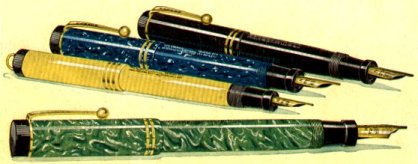
It is kind of intriguing to note that pens of the very sort I was obliged to write with in my school days are being sold today as calligraphy pens, not fountain pens as they were called in my youth. I think that name came from the way ink would cascade in fountains over your fingers, or your books and your lunch when they leaked in your bag. Very satisfying to write with, but I wonder if they have fixed that little anomaly.
Way back in the 1980s, when typing text was just about all you could do on a computer, school teachers were going through a bit of a crisis in the teaching of literacy. They claimed that children got all traumatised if their written work was corrected, so they didn't. There is a generation out there that can barely spell or punctuate. It seemed impossible to convince most teachers to let the kids use these new computer thingies to type their compositions, because they could correct them and end up with clean copy. One teacher of my acquaintance who did use a computer this way claimed that the kids got huge satisfaction out of it, but in those olden days the one class computer had to be severely rationed among the class.
Now that computers can do practically anything and kids wander round with thumb drives on tapes around their necks and every classroom has a smart board, the one thing they do not seem to do is use them for straightforward compositional writing. My granddaughter is a terrible speller, and she was amazed to discover that she could produce a perfect assignment by correcting the spelling on the screen. They can google, they can email, they can rip MP3s, they can edit photos, they can even produce beautifully formatted text work in amazing fonts with clip art, but they don't use the technology simply to help them spell or punctuate.
In the middle ages they recognised that there was a difference between reading and writing literacy. There were people who could read but not write, like Charlemagne and many women. There were scribes who could painstakingly copy out letters and words without much comprehension. That is why they made so many mistakes.
Today we demand high levels of competency at both aspects of literacy, so it would make sense to make use of all the tools at our disposal: pens for learning letter forms and wiring our brains for understanding them; computers for developing fluency, correcting mistakes and encouraging original composition. It couldn't possibly be the case that both sides of the debate could be right, could it?
It is kind of intriguing to note that pens of the very sort I was obliged to write with in my school days are being sold today as calligraphy pens, not fountain pens as they were called in my youth. I think that name came from the way ink would cascade in fountains over your fingers, or your books and your lunch when they leaked in your bag. Very satisfying to write with, but I wonder if they have fixed that little anomaly.
Way back in the 1980s, when typing text was just about all you could do on a computer, school teachers were going through a bit of a crisis in the teaching of literacy. They claimed that children got all traumatised if their written work was corrected, so they didn't. There is a generation out there that can barely spell or punctuate. It seemed impossible to convince most teachers to let the kids use these new computer thingies to type their compositions, because they could correct them and end up with clean copy. One teacher of my acquaintance who did use a computer this way claimed that the kids got huge satisfaction out of it, but in those olden days the one class computer had to be severely rationed among the class.
Now that computers can do practically anything and kids wander round with thumb drives on tapes around their necks and every classroom has a smart board, the one thing they do not seem to do is use them for straightforward compositional writing. My granddaughter is a terrible speller, and she was amazed to discover that she could produce a perfect assignment by correcting the spelling on the screen. They can google, they can email, they can rip MP3s, they can edit photos, they can even produce beautifully formatted text work in amazing fonts with clip art, but they don't use the technology simply to help them spell or punctuate.
In the middle ages they recognised that there was a difference between reading and writing literacy. There were people who could read but not write, like Charlemagne and many women. There were scribes who could painstakingly copy out letters and words without much comprehension. That is why they made so many mistakes.
Today we demand high levels of competency at both aspects of literacy, so it would make sense to make use of all the tools at our disposal: pens for learning letter forms and wiring our brains for understanding them; computers for developing fluency, correcting mistakes and encouraging original composition. It couldn't possibly be the case that both sides of the debate could be right, could it?
Monday, January 10, 2011
It's Personal
There is something about handwriting that links us to the writer; or at least, we are under the delusion that it does. I must admit to a naive delight in handling a scrap of paper or parchment that a real person has toiled over, marking in their own quite individual way, even if that person is entirely unknown to me.
I guess that is why people collect autographs. A cricket bat or a sports shirt or a CD or a concert program or a book is all very well as a piece of memorabilia, but so much more desirable if somebody associated with it has scrawled their signature and a message on it. I guess we feel in some way that it connects us to our heroes.
When I was a young thing at school, all the authors that we read were dead. So recently I resolved to make an effort to read some literature by people who are still alive. That's how I came to be reading Zadie Smith's The Autograph Man. Somewhat depressing book, full of screwballs and losers. Perhaps the saddest thing about it is that the protagonist (he could not be called a hero), who trades in autographs but is only interested in collecting for himself the autograph of one elderly film actress, ends up discovering that he has invented a persona and a life quite different to that of the owner of the autograph.
I guess we might be doing the same thing when we immerse ourselves in those historical documents penned by people involved in the affairs of the day. Still, when you know that somebody was clerk of the council during the minority of Henry VI, became bishop of Chichester as well as Keeper of the Privy Seal, and ended up murdered in the street by a mob in Portsmouth because the folk were angry about the losing of some possessions in France, you have to think that your romances and fantasies could be no more exotic and out there than the simple historical truth. It's not just paleography any more, it's personal.
I guess that is why people collect autographs. A cricket bat or a sports shirt or a CD or a concert program or a book is all very well as a piece of memorabilia, but so much more desirable if somebody associated with it has scrawled their signature and a message on it. I guess we feel in some way that it connects us to our heroes.
When I was a young thing at school, all the authors that we read were dead. So recently I resolved to make an effort to read some literature by people who are still alive. That's how I came to be reading Zadie Smith's The Autograph Man. Somewhat depressing book, full of screwballs and losers. Perhaps the saddest thing about it is that the protagonist (he could not be called a hero), who trades in autographs but is only interested in collecting for himself the autograph of one elderly film actress, ends up discovering that he has invented a persona and a life quite different to that of the owner of the autograph.
I guess we might be doing the same thing when we immerse ourselves in those historical documents penned by people involved in the affairs of the day. Still, when you know that somebody was clerk of the council during the minority of Henry VI, became bishop of Chichester as well as Keeper of the Privy Seal, and ended up murdered in the street by a mob in Portsmouth because the folk were angry about the losing of some possessions in France, you have to think that your romances and fantasies could be no more exotic and out there than the simple historical truth. It's not just paleography any more, it's personal.
There are people who claim that all history is fiction, but who cares!
Photograph by permission of the National Archives, London E28/G8/18
Subscribe to:
Comments (Atom)