Contributors

Showing posts with label pictorial representation. Show all posts

Saturday, March 26, 2016

Literacy: Words and Pictures: The Index

  Just another list of previous blog posts on a theme. I guess it ties the books/paleography and the material/culture/heritage strands together. That's my story and I'm sticking to it.


And to illustrate the concept here is this amazingly retro gif from when gif meant grungy old monochrome picture, not video of cats pole vaulting.

Medieval History and Modern Literacy A first inchoate thought.
English 4 U The language never did stand still.
Text, Image, Manuscript and Multimedia About padded lamp posts in London.
Medieval Musical Literacy Oh, and music.
National Curriculum and Literacy Dianne goes off about the ignorance of politicians again.
Writing and Remembering Did medieval readers remember more stuff?
Kids, Computers and Literacy Education Dianne goes off about ignorant politicians yet AGAIN.
Reading and Listening Reading with your ears, medieval style.
Eeee! Books About the e-book hysteria. Postscript: Why is Kindle still not any good?
Literacy Teaching - Again! I did get a little wound up about this topic around then.
Literacy through Mouse or Quill? She's at it again.
Books Online or Online Books? Bit philosophical here. Is a book a thing or a concept?
Angels Ain't Angels Reading a stained glass window on the nine orders of angels.
Corporal Acts of Mercy Reading another medieval text, in stained glass and wall painting.
Medieval Literacy: Pictures and Text More about the art of reading a story in pictures.

Sunday, March 20, 2016

Gotta Love Antiquarians

  The other day I was excavating some archaeological deposits in a bottom drawer and found some yellowing notes I had taken years ago from William Stukeley's Itinerarium curiosum. I had completely forgotten I had taken them. It was a while ago and I got distracted for a decade or so. Sometimes real life gets in the way of your cyberlife. I have a bit of a passion for antiquarian writers and illustrators. They tend to be looked down on a bit by academic historians of the serious serious scholarly variety because of their eclectic magpie style of collecting random information and some lack of rigour in checking it, not to mention their fondness for dodgy etymologies, genealogies, intricacies of heraldry, corporation minutes recorded in endless detail, scandalous doings of the aristocracy, and their penchant for putting little historical treasures into their pockets.
  The point is, they saw things at a particular time and from the mindset of that time. They saw things that have gone. Their perceptions of particular eras of the past are different to our own. When you read them, you are not just looking at the past, but at past perceptions of the past.
  Many of their works are now hard to come by, or were, until the Internet Archive started reproducing them in some numbers. Farewell interlibrary loan slips and visits to rare book rooms. Hello antiquarian world delivered to my desktop.


  At the simplest level they can show you what something looked like when it looked different to the way it does now, as with this picture of Beverley Minster with a little dome over the crossing, from C. Hiatt 1898 Beverley Minster, an Illustrated Account of its History and Fabric: London.This is reproducing an engraving that was old when the book was published.


  They can show you things that are not able to be seen any more, as with this grave slab of an abbot from the long disappeared Meaux Abbey near Beverley, from G. Poulson 1840 The History and Antiquities of the Seigniory of Holderness ... Vol.2: Hull. This work describes various relics that were located in farm buildings near the abbey site at the time.


  Urban renewals of the 19th century resulted in the removal of many picturesque, but probably uncomfortable and unhygienic, dwellings, changing the whole appearance and sense of the town environment. This example was once in Boston, from Pishey Thompson 1856 The History and Antiquities of Boston: Boston and London.


  Some public buildings or monuments of a town have been demolished, such as this market cross at Harewood, from J. Jones 1859 History and Antiquities of Harewood: London. This is quite symbolic of the changing status of the place from a small market town to a village that could be moved holus bolus out of the country estate at the whim of the local landowner.


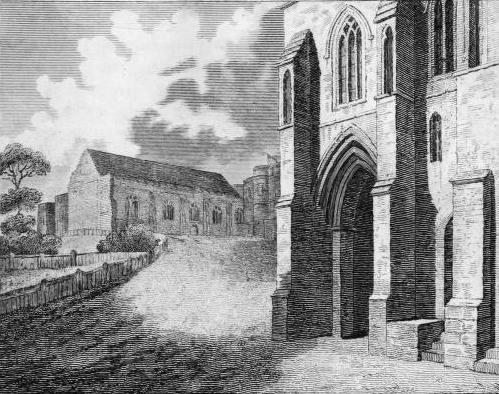
  They can strip away the modern urban clutter and give you a different sense of how the spaces in a town worked, as in this picture of the Westgate and castle hall at Winchester, from J. Milner 1809 The History, Civil and Ecclesiastical and Survey of the Antiquities of Winchester, Vol.2: Winchester.
  No, they are not photographs, they are interpreted pictures. Actually photographs can be quite interpretive too. The engravings follow certain conventions, like inserting rustic yokels with livestock into every scene with a derelict old building and often exaggerating the ruinousness of ancient sites for romantic effect. These in themselves convey something of the attitude of the writers and illustrators, working within their own time and space, to not only the remains, but the historical era they came from.
  The words they wrote also reveal their attitudes to the eras they describe. I am not looking for some ultimate historical truth here, but how the perception of an era, and the perception of places within a certain era, is built up in multiple layers as ideas develop, alter, get refuted, get reinvigorated. The events of history are reflected in patterns on the ground, in the design of towns, in the shapes of the countryside. The attitudes to history are reflected in the words and pictures used to describe them.
  The antiquarians are providing a link between two projects which I started as multimedia projects long ago, with an emphasis on visual evidence; an examination of the way John Leland saw the country and places in it immediately after the Reformation when much religious urban infrastructure was torn down or allowed to moulder away, and a view of how modern towns of medieval origin reflect their past, even as they incorporate modern urban institutions into their fabric. Actually, the antiquarians are not so much a link as part of a weave of historical and contemporary observations over time.


  To celebrate my discovery of my Stukeley notes, and the fact that the Internet Archive has a facsimile of his book, he has been incorporated into my Flickr Tour of Boston. The engraving above shows the famous church towering over a scruffy little town with a wooden bridge over the river. He describes it as a place much decayed, its warehouses shut down and various buildings demolished. He describes little antiquities he has found (and palmed) and repeats bits of antiquarian gossip he has acquired.
  These Flickr tours are my work in progress, as I turn a mountain of decomposing slides and early prehistoric scans of same into a useful data bank, excavate old material from Word files extracted from obsolete multimedia file formats using an old computer that had to be given periodic offerings of mammoth meat to keep it going until the job was done, and swap crayola graphics for Google earth pictures and the like. It may all make sense one day. Feel free to browse the Flickr Collection of Leland Tours, but don't expect it to look like a big picture for a long time yet. This is called working in public.
  Meanwhile, under the Stukeley notes was another set from a book by one William Bray who went touring around, mainly in Derbyshire and Yorkshire, publishing his observations in 1783. Heading north through Yorkshire he refers to "and other hills in the horizon, on one of which the White Mare of Weston Cliff, or White Stone Cliff, is visible on a clear day" In a footnote he explains "A mark in a hill, like the White Horse in Berkshire, Whiteleaf-cross in Bucks etc." Now the current wisdom claims that the white horse of Kilburn, located on Whitestone Cliff where it can be seen when travelling from York to Thirsk on the A19, was created in 1857 by a local schoolmaster, with the help of his pupils, because he didn't see why they should only have hill figures down south.

Image by Tony Wells, via Wikimedia Commons
  
  So what did William Bray see? Was there some sort of precursor to this figure there? Did the local schoolteacher have some knowledge of something that used to be there, but wasn't any longer? You can always find surprises in antiquarian books. 
  Next stop the two Williams, Stukeley and Bray, will be visiting Leicester. And there might be some new tours of little places of no great complexity, until I get the rest of the raw material in order.
  I always hated Dickens in high school, mainly, I think, because our dopey teachers tried to present it as high art rather than jolly ripping yarns. Not so long ago I went back and read The Pickwick Papers. The ever so important Mr Pickwick and his gang of wandering buffoons are a wonderful, joyful send up of these folks rambling around the countryside looking at stuff, then giving talks to each other about it, not to mention getting into all manner of scrapes and japes. Even back then some of these folks were considered to be amusing. We should be grateful for their curiosity.

Saturday, February 27, 2016

Medieval Literacy: Pictures and Texts

  I have recently been plodding through organising, optimising and recataloguing a large number of digitised slides of the stained glass of York Minster. I spent quite a bit of time in York and managed to photograph a fair swag of the city's magnificent medieval glass, but I didn't have a cherry picker or a drone so there is a fair bit of fiddling about with enlarging details and seeing if they come out. Also my identification of the individual windows was not quite as accurate as it might have been. So with the trusty Pevsner and a pile of other reference books on the desk, I am putting Humpty Dumpty together again.
  The process has jogged the brain into mulling over the whole question of the nature of medieval literacy and the old chestnut about church art being the Bible of the illiterate. For starters, literate and illiterate do not need to be polar opposites. Medieval people read what they needed or wanted to read, whether it was their own names, the oft repeated prayers and psalms in their books of hours, their household accounts, the texts of sermons they were about to deliver, or complex philosophical treatises requiring knowledge of several languages. The same applied to writing. Some scribes copied stuff literally, some made notes from the spoken word, some specialised in formulaic legal documents and some authors wandered round dictating their thoughts to hapless secretaries.


  York Minster is a big building, with very tall windows filled, in many cases, with fiddly detail, especially the 14th century windows with multiple small panels full of colour. It's very hard to simply read the windows without any background or prompts. A photograph like the one above of a window in the north side of the nave gives a bit of an idea of what you actually see. Who is doing what up there and why does the window seem to be hung about with little golden bells?


  The window in question was, in fact, donated by the bellfounders. A telephoto lens shows a kneeling donor presenting the window to St William of York himself, and he is bestowing his blessing on the bellfounders. This panel is at the bottom of the window so it is easier to make out than some, but medieval folks did not have telephoto lenses. No doubt people were told the story of the bellfounders and their donation, and all those little bells just reminded them of it.


  Something similar must apply to the windows which tell the stories of morality and martyrdom and the episodes of the Bible. In peering at the images trying to tell which window was which, I found myself searching for those visual clues that permeate every visual retelling of the story, because for all the variations of style and medium, medieval church art used a standard repertoire of symbols to represent each story. The window above tells the story of St Catherine of Alexandria.


  The episodes of the life of St Catherine are played out in a series of pictures which follow the story exactly as it is told in the Golden Legend. The panels are detailed, even after centuries of damage and restoration, but quite far away. These stories would have been known to the lay congregation mainly from oral teaching. Not too many folks would have had a copy of Jacobus de Voragine in their personal library, but they would have heard the stories many times. They would also have seen the stereotyped images of saints in their books of hours or prayer books, if they were so fortunate as to have one. They learned the stories, recognised the imagery and could follow the sequences in the art in the church. Is this literacy or illiteracy? I say it is a form of literacy. Word and image reinforced each other in medieval books, as well as on windows and walls.


  The story of St Catherine is told in exactly the same type of strip cartoon form on the nave wall of Pickering church in Yorkshire. It was an accepted way of narrating and imaging a well known story. The philosophers, the prison, the flogging, the wheels and the grand finale with the beheading with a sword: that tells the story. You read it.


  The nave clerestorey windows are way, way up. The top row of scenes are actually 12th century glass from an older cathedral on the site, but they must have thought it was worth saving. What the hell is it? Ah. That was a clue. On the right there is a great big mouth with chompy teeth with people going into it. Other panels seem to have people being poked into a pot.


  Hell is what it is. At one time pictures of the Last Judgement were all over the chancel arches of many churches, possibly most. There they were large and easy to see, and were no doubt explained in gruesome detail by some of the more charismatic preachers. Literate or illiterate, the basic clues tell the story.


  In the formerly Benedictine church of Blyth the Doom painting is faded and battered, but it was big and conspicuous in its heyday.


  The nasty demons poking people into hell were suitably demonic. The whole image is a story which can be read, not just a picture. Benedictine monks were not illiterate. They could read those little black marks scratched on to pages, but pictures could be read as well. Even if you could just make out the big chompy teeth in the distant window, you were reading the story. 


  Even a single figure is not just an image, but represents a story. St Christopher carrying the baby Jesus across a river is one of the more dubious bits of Christian mythology, but it was a story popularised in the Golden Legend and he is one of the most prolifically illustrated saints. This is a 15th century example from the windows of York Minster, but while the size and boldness of the 15th century glass makes the image easier to see from the ground, the story has to have been learned. 


  In the parish church at Easby the founding myth of the Jewish and Christian religions is depicted on the wall. It is read from left to right, just like writing. It is a story that was codified and solidified by being written down, then copied and recopied. It can be read in the Bible, or in excerpts, or in paraphrase, or in pictures. Or it can be learned by listening. Bible picture books were produced for wealthy aristocratic patrons in which the stories were paraphrased with words and pictures. They were for literate people, but literate people used pictures too. Literate clerics used historiated initials to help them find particular passages in their psalters or lectionaries, because the iconographic code had rules and conventions, just as writing did.


  So trying to identify exactly which window I'm looking at is very analogous to how a medieval person might read that window. What is that panel in the middle? Man looking over left shoulder, somewhat startled, at an angel in the sky, with sheep wandering about.


  Joachim in the wilderness. Back story to the life of the Virgin and the early life of Jesus. Christian mythology known from the Golden Legend, filling out some unsatisfactory gaps in the Gospels. The window tells the story. You just have to know how to read it.


  Upside down saint. Martyrdom of St Peter. Now what else can we recognise to see what story this window is telling?


  Kings in vegetation. Jesse tree. Genealogy of Christ. From the York Minster choir but originally from New College, Oxford, where we can presume the congregation was reasonably literate.
  We may regard many medieval folks as less literate than ourselves, but in many ways they may have been more literate, with minds open to different ways of telling stories.

Friday, September 19, 2014

Corporal Acts of Mercy

  A couple of posts ago I compared two programs in stained glass windows in York, one from the magnificent All Saints North Street. This one also looks at a window from that favourite church of mine, but compares it with a wall painting in the parish church of Pickering in Yorkshire. This is another in strip cartoon style, representing the Corporal Acts of Mercy. This theme is not so foreign or exotic as some in medieval iconography, as we are still carrying out those same functions today for our brethren who have fallen on hard times, whatever our religious persuasion, or lack of it.
  The concept, unlike many in medieval Christian iconography, comes straight from the Gospels. "For I was hungred, and ye gave me meat: I was thirsty, and ye gave me drink: I was a stranger, and ye took me in: Naked, and ye clothed me: I was sick, and ye visited me: I was in prison, and ye came unto me." (Matthew 26:35-36, from the one and only King James version). This is the road to salvation, so it is perhaps unsurprising that a wealthy patron might wish to have himself commemorated performing these acts, as appears to be the case in All Saints, North Street, where a benign, bearded elderly gent presides over every panel.


  The acts of mercy are represented in the two central rows of panels. The bottom row contains images of kneeling donors and an image of the sun and planets, which may or may not actually belong here.


  To feed the hungry, the virtuous man doles out loaves of bread to beggars with the help of a faithful servant.


  To give drink to the thirsty, he pours liquid from jugs into bowls with the aid of the same wee servant. Note that the figure in front is walking on padded knees with little stools under his hands; one of the desperately needy.


  He takes in the stranger by welcoming a couple of travellers with walking staffs into his home. I'm not too sure whether that is supposed to represent a cockle shell on his hat, indicating that he too has been a pilgrim to Santiago de Compostella. I may be over-reading it here.


  He clothes the naked with some spiffy red garments, once again with the help of the faithful servant. Medieval guys wore boxer shorts evidently.


  He visits a sick man, bringing some sort of gift - might be money, or bread, or home baked goodies. Probably money, I think. The wife of the sick man seems quite overcome. Note the commode by the bed. The 15th century glaziers of York were quite partial to this as a symbol of illness or impending death.


  Finally he visits the prisoners, not in some dungeon vile, but in the town stocks. Best of all, he has brought a large purse into which he is dipping his fingers. Presumably he has payed their fines. Perhaps it is easier to be virtuous if you are rich.

  The wall paintings in Pickering church are faded and less vividly coloured, not to mention difficult to photograph as you are firing into the clerestorey windows. They are also enthusiastically restored, but the scheme is still there. This church contains an array of paintings of some of the most popular motifs in late medieval art, but we will look at this one for now. 


  The individual panels slightly overlap one another, giving the look of a continuous scene.


  In this sequence a beardless young dandy dispenses the goods, in this case loaves of bread to a couple of long haired wayfaring strangers who look alarmingly like George Harrison and John Lennon from the late 1960s. This seems to combine feeding the hungry with taking in the strangers.


  These same two enjoy a quaff from a bowl which has been dispensed from a jug.


  The young man has also dispensed a garment which seems to be a bit difficult to get into, as the wayfarers proceed on their journey. If you are wondering, as I was, why a large spear might be considered a merciful thing to give the needy, I think the figures on the right actually belong to the next scene, as follows.


  The benefactor is visiting a prisoner in a cell. As he is holding a large purse, I presume he has bribed the jailer to lower his weapon. The grateful fed, watered and clothed hippies seem to have come along to help, or perhaps they are just wayfaring on.


  Here he visits the sick bearing some sort of gift, again with a somewhat overwrought wife in the background.


  The final panel represents the burial of the dead. This is not mentioned in Matthew, but it makes up that favourite number seven, and is undoubtedly a merciful act, at least for the survivors.
  So what does this all have to do with Medieval Writing? Well it does show that texts can be represented in pictures, and were. I don't think it necessarily implies that the readers were illiterate, but just that the teaching and preaching tradition contained written, pictorial and oral elements which added up to a total experience in the church, which was undoubtedly a more colourful and exciting environment than any other in the lives of most parishioners. It also encouraged the worshippers to pray for the souls of the patrons and donors represented there, in the same way that medieval tombs did. That's a story for another day.
  I don't think I know of this pictorial program in a medieval manuscript, but they are probably out there somewhere. If you know of one, please tweet it to @HipBookfairy.