Contributors

Showing posts with label heraldry. Show all posts

Sunday, March 26, 2017

What's With Medieval Tombs? Part 22: Bling on Tombs

  Efffigy tombs of the 14th, 15th and 16th centuries always show people dolled up in their finest, adorned with various kinds of bling. Sure, they want to be looking their best when they arise at that last trump, but every item of expensive decoration embodies some kind of message about that person's position and role in society. It is a form of communication; a readable code.


  Effigies of ladies of the 13th or very early 14th centuries tended to all be very similarly dressed with a flowing gown and simple head covering, often with a wimple. The fact they they were depicted as large tomb effigies at all was sufficient testimony to their status. Most tombs of this vintage have been knocked around a bit, moved, and lost their colouring and gilding. They are ghosts of their former selves. The two ladies above are from Tideswell in Derbyshire.


  It has been said that fashion was invented in the early 14th century, with clothing styles for men and women undergoing rapid change. Having the very latest in fashions was an insignia of not only wealth, but status and influence. If the missus was dressed in the latest crazy headgear and sleeves with a million buttons, then she was not only rich, she undoubtedly had someone to help her get dressed in the morning, like this lady from Bothamsall in Nottinghamshire.


  In the days of sumptuary laws, if she was togged out in imported brocade, she was guaranteed to be of a certain status in the social hierarchy. The above is a replica of the brass to Margaret Peyton (1484) in Isleham, Cambridgeshire. These fashions changed so rapidly that the makers of effigies, whether brass or sculpted stone, were constantly updating their designs to keep up. Where the tomb has an inscription it is possible to create a chronology for these fashion changes but in the absence of one, I have doubts about identifying the tomb owner by cross referencing the date of death with the fashion design. It may date the effigy accurately, but it would depend on whether it was made before death (It's been done.), immediately after or some years after.


  Here is a bit of gratuitous female bling from Methley, Yorkshire, because bling looks so good in alabaster. Amazing hat.


  Something similar happened over the same period with the depiction of knights. The example above is an early 14th century effigy from West Tanfield, Yorkshire, turned out in chain mail. The evolution to plate armour and beyond took place as a series of specific details which resulted in a very different final result. Funerary effigies depicted these changing details of body armour, sword belts, shields, spurs in intricate detail.


  This knight from Harpham, Yorkshire, displays the lean, clean and mean look of full plate armour of the early 15th century, apart from the frivolous crown of feathers on his helmet.


  Some later depictions, such as this late 15th century knight from Howden, Yorkshire, have strangely exaggerated features of some parts of their armour, as if the novel features were being emphasised. As with the ladies, although armour can be dated stylistically, it probably dates the manufacture of the effigy rather than the demise of its owner. The medieval art tradition generally had a strange anachronistically modern approach. Alexander the Great's armies wore 15th century armour if they were depicted in a 15th century chronicle, as did King Arthur's knights.
  Armour, at one level, might not be considered technically bling. It was practical attire to stop you getting murdered in battle. It was, however, very much a sign of status. Being entitled to a suit of armour meant you were entitled to risk getting yourself murdered for the king. You had rank. There is nothing to say that the actual practical armour that your average knight kept in case they had to clobber the French again was as perfectly in synchronicity with fashion as the one they were depicted with on their tomb. By the Tudor period, upwardly mobile city merchants who were granted knightly status ordered a suit of armour to prop up in the banqueting hall, just to show.


  Heraldry was bling, and also subject to the rapid elaboration over those competitive centuries as seen in clothing and armour. A simple coat of arms on a shield may have sufficed in the early 14th century, but these were often depicted in a colouful and blingy way. This battered brass of a knight from Gorleston in Suffolk bears a small shield that has a roughened surface to hold enamels or resins to display the heraldic colours.


  This brass from Chesterfield has gone the full monty. Terrible photo, sorry. Because of the way tombs have been messed around over time, sometimes the full heraldic bling is not preserved as it could include arms on the tomb chest, in an archway or above a niche. The whole ensemble is often not in its original condition. Somebody versed in the arcane language of heraldic depiction could tell a whole story of family fortune from the brass above.


  A significant bit of knightly bling was the livery collar, becoming apparent during the Wars of the Roses, supposedly to indicate where loyalties lay: SS for Lancaster, suns and roses for York and S with roses for the Tudors to show we are all lovey again. The above examples all come from Harewood church in Yorkshire.  If they really show loyalties, this mob did tend to go with the flow. They are sometimes found on female tombs as well, as in the example from Methley above. There is a difficulty in interpreting the significance of these. They are taken to indicate allegiance. In contradictory mode, they are often used for dating, identifying the precise owner of the effigy by the reign of the monarch that they died in. Both cannot be correct. If everyone had been on the side of the current winners, there would have been no war. Perhaps it didn't show so much which side they were actually on, but how their descendants wanted them to be remembered.


  They were not all fraught with royal controversy. This example from Ripon in Yorkshire wears a collar depicting a deer within a park, a local badge of the Markenfield family. He evidently preferred to advertise his big fish in a smaller pond status.


  Certain styles of bling denoted particular offices. This battered effigy in Eastrington, Yorkshire, wears the robe and coif of a judge over the suit of armour of a knight; not a combination he would have worn in real life. He really wanted to hit the viewer with all his status symbols.


  A mayor of Norwich flaunts his fur lined ceremonial robe and beads, significata of office.


  If you didn't rate a suit of armour, you could advertise your significance with the size of your purse, as with this civilian tomb in Ashover, Derbyshire. Presumably this was meant to indicate the amount you were prepared to give to charity for the benefit of your immortal soul, but a purse that size is definitely bling. They kind of missed that bit about the camel and the eye of a needle in the middle ages.


  Even at slightly less elevated levels of society, a bit of bling denoted special status. This rather lumpy battered effigy from Wadworth, Yorkshire, carries a hunting horn, symbolic of his role as a forester. In less complex tombs, symbols such as swords, chalice and paten, keys, shears and the like serve as a communication system for information about the status of the deceased.


  The ultimate bit of swank was if your dog was wearing bling. This fine hunting dog, a status symbol in itself (Hey, you didn't have a dog that could bring down a deer unless you were entitled to hunt the deer.), on a knightly alabaster tomb in Halsham church, Yorkshire, was probably sporting some real bling in his heyday.
  In the religious community, clothing and bling had very specific references to the status and function of the wearer, but that is a story for another day.

Sunday, May 15, 2016

What's With Medieval Tombs? Part 20: Owning the Church

  My sorting and cleaning up of old photographs finally allowed me to identify two pictures which recalled a tale from when they were originally taken. I was trailing two small boys around medieval sites at the time. Mostly they were happy with castles and didn't mind monasteries if they had good drains, but churches generally had to be rationed. They were observant little lads though and as I was investigating a tomb one queried "Why is the shield in the stained glass window the same as the one on the knight's shield. Did he own the church?" I explained no, he didn't own it, but he may have had something to do with building the part of it where he was buried. Thinking about it for a few decades, there is an element of ownership in these remains, and sometimes contested ownership at that.


  The church was in Ryther, West Yorkshire, where there are tombs to members of the Ryther family. In an earlier post I discussed how stained glass windows could be funerary monuments in themselves, and could contain specific references to praying for the souls of the dead. Another post also discussed the use of heraldry on tombs as an identifier and a status marker. I guess I am trying to pull a few threads together to look at signs of possession within the church.
  There must always have been some competition between the clergy and the wealthy lay folks about ownership of the church real estate. The clergy used the space to go about their business of saying the offices and the mass, conducting weddings, baptisms, confessions and funerals and doing their own work. It was their space. Nonetheless, wealthy donors provided some of the means for them to do it, and laid claim to spaces for their personal and family display.
  Some of the earliest large effigy tombs are in the great churches, the cathedrals and abbeys, commemorating the senior clergy of the church; the founding fathers and those who oversaw the development of ever increasing grandeur of these buildings and communities. These can be seen in some places, despite being moved and messed around during the course of various religious upheavals.


  The Purbeck marble tomb to Bishop Joscelin de Bohun (d.1184) in Salisbury Cathedral is one of several of senior ecclesiastics in this church.


  Abbot Benedict (d.1193) is one of a number of abbots who survived the Reformation and remain commemorated in Peterborough Cathedral after it was changed from a Benedictine abbey. They weren't forgetting their origins in Peterborough.
  Ecclesiastics were not the only people memorialised in the abbeys, even those which did not serve as cathedrals. Although one might think of the more remote Cistercian houses, for example, as places that were largely the preserve of their serving monastic communities, significant lay people were buried there, having paid well for the privilege no doubt.


  This mangled specimen of a knightly effigy lies in the ruins of Jervaulx Abbey. Nobody salvaged him and carted him off to a safer haven at the dissolution of the monasteries. His capacity to own a piece of monastic territory was subverted by the disappearance of the institution itself.


  A hefty but battered tomb of Sir Ralph Bowes stands plonk under the crossing of the church of Egglestone Abbey, a Premonstratensian house. More modest slabs and brass indents are scattered about, of lay and ecclesiastical figures. This was a bit of a battling house and probably had to treat its patrons well.


  At Fountains Abbey some battered relics of the tombs of the abbots lie in the chapter house. This was a space where the monks conducted their own affairs and could perhaps be perceived as their particular space, even more than the body of the church was.
  In the later medieval period, the claiming of space in the major churches, by ecclesiastics as well as mighty lay people, became even more conspicuous with the building of lavish chantries, marking out confined spaces within the general area of the church and splashing heraldry and other symbols of ownership all over them. They were for the wealthy, religious or lay, as they not only required payment for their construction but ongoing expenditure to maintain the priests who said the masses in them.


  Entrance to a chantry in Ely Cathedral. Now imagine it with all its colour and statuary; definitely laying claim to a space.
  In the parish churches, it seems the wealthy local laity had the upper hand. While there are some fancy tombs to parish priests, there are many more modest little affairs and a lot of them are small brasses.


  This tiny brass to a priest in West Tanfield church, North Yorkshire, sits in a church with several large and elaborate effigy tombs to the laity. Who provided these modest memorials - family, parishioners? I don't doubt there may have been some battles, and some rearrangements over time, as the priests tried to ensure they had the space to do their business while the lay patrons tried to impose their memorials in the most conspicuous places.
  Stained glass windows do not occupy floor space and they do serve useful and aesthetic functions within the church. Heraldic windows emblazon the family stamp on the place without getting in anybody's way, which might explain why you find so many of them.


  The above is an assortment of glass fragments in St Martin's church, Stamford, featuring some natty heraldic shields.
  I suspect some competition among the laity themselves for ownership of space as family fortunes waxed and waned. There are plenty of clues that tombs got moved around and re-organised and it is not always clear when. The older, and often a bit forlorn, effigies seem to be usually found in churches that are not crammed with the clunky memorials of post-Refomation upstarts, whether they are in tiny country churches or tucked away rather surprisingly in modern industrial towns (or post-industrial in many cases today). Tomb chests show signs of having been broken up and reassembled. Effigies look to have been dragged outside and left in the rain. In some cases they have been found buried in the churchyard or tucked into strange places inside the church.


  This alabaster couple in Pickering church lie in what looks like a family chapel, but if they haven't spent some time out in the North Yorkshire dreek I would be very surprised.


  Then there is this. Several tombs of the de la Pole family reside in the church at Wingfield, Suffolk, a church which became collegiate under their patronage. Note the location of the tomb up next to the altar and the way that various heraldic devices spread all over the aisle arcades of the chancel. The sedilia are actually built in to the structure of the tomb. Another tomb lies directly opposite on the other side of the chancel. These folks are still owning the church.
  We like to have a romantic notion of medieval churches as havens of peace, love and Christian values, but it is very hard for those competitive, acquisitive, pugnacious creatures we call people to leave those characteristics at the door. The battle for status and influence continues inside, using the vocabulary of the sacred spaces.

Sunday, April 24, 2016

What's With Medieval Tombs? Part 19: Animals on Tombs (2)

  The first posting on this topic examined some of the generic types of animals depicted on tombs and what they signified in general terms. In this post I will look at some more specific examples of how animals were used in a way the referred to particular individuals. One of the ways of individualising tombs was through the use of heraldry, as the depictions of the actual effigies were generally highly generic and indistinguishable. Animals had their place in achievements of arms. Unfortunately, in many cases the heraldry is lost to us as it was painted on to shields adorning the tombs, and has been effaced in that phase of church restoration that insisted everything should be monochrome.


  The 13th century tomb of William Longspee in Salisbury Cathedral has six prominently carved heraldic lions on the shield. This example has some significance in the history of heraldry as his grandfather, Geoffrey Plantagenet, was supposedly the first person to be granted a personal coat of arms. So they say. The lions on his tomb in France were made in a more durably colourful medium, but William's have been reduced to monochrome. This dynasty did not have a monopoly on lions however, just on this arrangement.


  The early 14th century brass to Sir Robert de Bures in Acton, Suffolk also features lions on the shield. These are the very stylised heraldic lions whose poses all have fancy French names. Heraldry is basically a bunch of patterns arranged in different combinations. During the course of the 14th century these combinations became more and more complicated.


  This tomb of a 14th century knight in Melton Mowbray church has a nice heraldic lion shield, but as no colour remains on the rest of the effigy it has presumably been repainted. It may even have been reappropriated with the help of said lion for somebody who needed some ancestors. Still, it gives you the idea of how these things could be used.


  Lions were not just heraldic symbols, but represented Christian virtues and were deemed to represent Christ. The rather strange books known as the bestiaries ascribed all manner of characteristics to various animals, all with overlaying connotations of virtue or sin. According to the bestiaries, lion cubs were born dead and were revived on the third day by the male lion breathing in their faces. Anything sound familiar here? For those and many other equally spurious reasons, lions were cool, tough and virtuous, and were found as foot supporters on many effigy tombs, as shown in the previous post. The mid 14th century knightly effigy from Pickering, Yorkshire, above has the emblem of a lion's head on the elbow piece of his armour; a medieval version of the saying "more power to your elbow".


  When the lion fought the dragon it represented Christ fighting the devil, as on this corbel tucked away inside the famous so-called Percy tomb in Beverley Minster, Yorkshire. It is not the only piece of hinted Resurrection symbolism on this tomb, suggesting its possible use as a Easter Sepulchre.


  Above is the Percy tomb in all its glorious complexity.


  As heraldic achievements became more and more complicated, animals appeared in other places, such as on the crest of the helm of a knight, used as a rather uncomfortable pillow in funerary effigial depictions. The late 15th century brass to Nicholas Kniveton in Mugginton church, Derbyshire has an animal that looks like a wolf as the crest. However, the composition recalls the bestiary story about the tiger. When a hunter steals a tiger cub, he can throw the indignant mother tiger off his trail by throwing her a glass ball which acts as a mirror. She peers in the mirror thinking that it is her cub and the hunter makes his getaway. It doesn't look much like a real tiger but it does look like the way the tiger was depicted in the bestiary, mirror and all. Is he telling us that he is as cunning and fierce as a tiger, or that he steals other people's offspring, or what?  He is wearing a Lancastrian collar during a Yorkist reign so I suspect he is telling us something.


  Animals were also deployed as shield supporters in heraldry. This fragmentary arrangement shows the supporters on the funerary achievements over the late 15th century tomb of Sir John de la Pole and wife Elizabeth in Wingfield church, Suffolk.


  This beat up specimen from Halsham, East Yorkshire may represent the head of a wolf, or something else fierce and hairy.


  The crest on the 15th century knight's tomb from Swine in East Yorkshire seems to represent a bird, perhaps an eagle.


From C.A. Stothard 1840 The Monumental Effigies of Great Britain, London
  It isn't just knights who can have fancy pillows. The late 14th century tomb of the wife of Lord Beauchamp in Worcester Cathedral depicts her with her head resting on a swan. I think this is unique.


  The knight's effigy on the brass of Sir Godfrey and Dame Katherine Foljambe in Chesterfield church, Derbyshire is a mid 16th century over the top extravaganza of heraldry, as is the rest of the tomb. His feet are resting on a stag. As this brass uses the convention of placing his feet on a grassy hillock, it makes it look as if he is standing upright and stomping on the stag.


  The animals, heraldic or otherwise, can be part of a play on words of the commemorated person's name, a trick known as a rebus. The early 14th century effigy of Sir John de Bordeston in Amotherby church, Yorkshire carries the emblem of three boars. (Boars, Bordeston, get it?) As heraldry became more complex it became less of a symbolic language and more of a pictorial one.


  The 15th century alabaster effigy of a member of the Redmayne family in Harewood church, Yorkshire has a crest of a horse, which no doubt had a red mane in its glory days.


  Sir Walter Griffith (d.1481) rests his feet on a splendid alabaster gryffon in Burton Agnes church, East Yorkshire. Griffith, gryffon; well it only has to be close.


  This gentleman, lying here serenely in Glastonbury parish church, bore the name of John Cammel (d.1487). Spot the camel.


  The early 14th century tomb of Sir Richard (or Robert) Stapledon in Exeter cathedral has the biggest and most conspicuous animal ever in the form of a horse, sadly mutilated, not supporting his feet but being led by a groom beside the feet of his effigy. Another effigy, perhaps a squire, stands by his head. Sally Badham, in her Seeking Salvation (2015) suggests that this could represent his funerary procession. Or maybe Stapledon, stable ... maybe, or both.


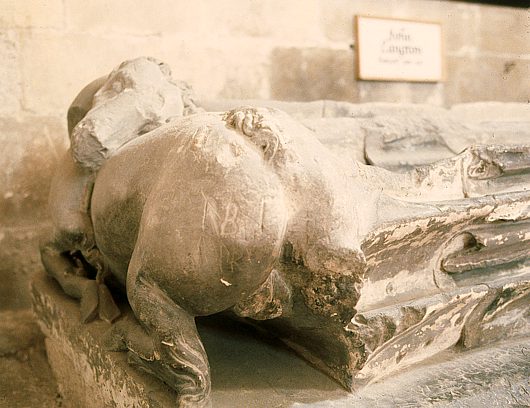
  I only include this picture of a horse as foot supporter for Bishop John Langton in Chichester Cathedral because I never met a horse that could do that.


  Finishing off somewhere near where we started, here is a lion foot supporter. Even as foot supporters go, it's a rather peculiar lion with strangely monstrous feet and it's biting at the sword tip in the way that dragons and demons do. It's a mixture of the noble Christian lion and the nasty bitey beastie. It stands at the feet of King John in Worcester Cathedral. Make of that what you will.

Sunday, February 14, 2016

What's With Medieval Tombs? Part 16 - Memorials in Glass

  So far in this series I have looked at medieval memorials that are essentially grave covers, at least in theory, although some of them depicted people who were buried in other locations, or only certain parts of them were buried at the commemorated spot, or their remains or tombs had been moved. Within churches there were various other ways of commemorating the dead, especially if their good works in life had included donations to the fabric or treasures of the church in question.
  Sally Badham's recent book, Seeking Salvation, gives copious examples of other church works which can be regarded as funerary memorials, indicated by inscriptions on walls and furnishings, church plate and many instructions in wills for donations to the church. Stained glass windows also come in here, and she points out that all of these are visual reminders to the congregation to pray for the souls of the departed to hasten their trip through purgatory.
  Purgatory was a big deal in the 14th and 15th centuries, when church art and commemoration was developing in elaboration, but as I have mentioned before, purgatory was an official church doctrine which allowed expression for concepts of liminality concerning death. Those concepts have been expressed in different ways in other times and in other religions and cultures.
  The 14th and 15th centuries were also a time when traditional social hierarchies were being challenged and social stratification, although well and truly still there, became very competitive. This was evidenced in many aspects of life, including rapidly changing fashion utilising fancy imported fabrics, massively competitive dining habits, more lavish houses for those who could have them, and posh book ownership. In competitive societies, worth is displayed by not only what you have, but what you can afford to give away. In societies with very different religious beliefs, funerary ceremonial could involve large and often complex redistributions of wealth. Funerals and mortuary gifts certainly encouraged others to pray for your soul, but also increased the standing of you and yours in society. Besides, they then made other people obligated to you and yours, should fortunes reverse.


  The simplest easily recognised visual symbol for the folks of the congregation was probably heraldry. The above example comes from St Martin's church in Stamford, Lincolnshire. They shields were often depicted being carried by little angels, which has parallels with the angels carrying the souls of the departed also found in funerary depictions. The heraldic device might indicate that the family concerned had built their own funerary chapel, or had contributed in some other way to the fabric of the church. These are very commonly found, sometimes sprinkled among the more didactic panels of the windows.


  Here is another example from a small northern town, Thirsk in North Yorkshire. I don't suppose the coat of arms actually represents three donkeys but it looks a bit like it. Such panels no doubt encourage prayers for the soul, but they also stamp a certain authority on the congregation.


   The de Mauley window in the south nave aisle of York Minster has eight coats of arms associated with the de Mauley family, sprinkled between the usual scenes of martyrdom and mayhem, and representations of members of the family in the lower panels. It has to be said that this is virtually a copy of the original window after a drastic restoration in 1903, but you get the idea. 
  Occasionally you can find a heraldic shield in a window that matches one on a tomb in the church, indicating that these are not either/or modes of commemoration but part of the whole cornucopia of ways that people could be remembered, respected and hopefully hastened on their way to glory.  
A more personal representation is found in the simple kneeling donor figure, usually found modestly in the bottom corner of the window.


  This somewhat effaced little figure from Thornhill in West Yorkshire is depicted in civilian clothes with his purse slung on his belt, not armour, reflecting the new order of town life when you could have influence with money rather than coats of arms. He is kneeling at his prayer desk with the prayer book open, which is about as clear a reminder of what you are supposed to do as you can get.


  This donor panel in St Michael-le-Belfry church, York has an inscription encouraging you to pray for the donor and his three wifes. The convention of showing successive spouses all kneeling together is not unusual. Time collapses when you're dead. Many donor panels contained these inscriptions, but some have been lost, accidentally or on purpose when the glass was reset in times of religious change. The desire to perpetuate the memories of families outlived the need to believe in purgatory. Similarly the "orate pro anima" part of tomb or brass inscriptions has sometimes been effaced, a symbolic gesture making the memorial correct in religious terms while still commemorating the departed, and reminding folks of the significance of the surviving families.


  This window in All Saints North Street, York has multiple references of this type. The kneeling donor  figures in the lower panels have come from a different window. Stained glass is always mixed up because of the need for regular repairs and renovations. Nevertheless they are two of several representations of this type in this particular church. The six panels above represent the corporal acts of mercy. I have written about this in another blog posting here. The acts of mercy are being administered by a benign looking bearded man who looks much the same in every panel, and it has been assumed that this figure represents the donor of the window; a reminder of how he has redistributed his wealth for the benefit of the parish.


  Furthermore he is rich and he wants you to know it, because he is using his wealth for virtuous purposes. Here he is dipping into his large money purse to bail out some prisoners in the stocks. Acquiring wealth is fine if you give it away in a virtuous manner. Pray for his soul please, and look after his heirs.


  The windows in the wealthy church that wool built in Long Melford, Suffolk display more of the symbols of power and less of virtue in the figures of the donors. Sure, they are kneeling praying so please remember to say a prayer for them, but they are togged out in very conspicuous heraldic rig, wearing their coats of arms all over them. They built this church and they are important.


  The nature of the donation can be made quite explicit. This kneeling donor in St Denys church, York, dressed in civilian clothes, is holding the window he has donated, just so that you know exactly the nature of his benefaction. This is analogous to those tomb figures of bishops and knights holding models of churches they have funded. And no, I don't know whether he was a wealthy beekeeper.


  Donors commemorated in glass did not have to be individuals. The guilds of the towns had the function of caring for the spiritual needs of their members as well as their conditions of work. This window in York Minster was presented by the bellfounders and some panels contain representations of aspects of the bellfounders' art. This panels shows the presentation of the window to the archbishop, with the usual supplicatory imagery and a depiction of the window in the glass itself, so everyone gets the point. It symbolises the social importance of the town trades, who are acting like aristocrats of old in their dealings with the community, as well as encouraging prayers for a group within the commnity. 


 The most famous examples of this type of commemoration are across the Channel in France, in the cathedral of Chartres, where all the various craft guilds which contributed to the building of the cathedral are commemorated in the amazing program of stained glass windows. They are not depicted praying or with symbols which specifically encourage others to pray, rather shown just going about their work, but they are included in the lower panels of the instructive windows. The examples above show the furriers and the drapers. Perhaps they somewhat predate the full expression of the concept of purgatory in church art, but their contribution to the church fabric and life is being appreciated.
  It is reasonable to regard these types of windows as funerary memorials in just the same way that we regard grave slabs or effigy tombs. They serve the same purpose and utilise similar iconography. They perpetuate memory beyond the grave.