Just another list of previous blog posts on a theme. I guess it ties the books/paleography and the material/culture/heritage strands together. That's my story and I'm sticking to it.
And to illustrate the concept here is this amazingly retro gif from when gif meant grungy old monochrome picture, not video of cats pole vaulting.
Medieval History and Modern Literacy A first inchoate thought.
English 4 U The language never did stand still.
Text, Image, Manuscript and Multimedia About padded lamp posts in London.
Medieval Musical Literacy Oh, and music.
National Curriculum and Literacy Dianne goes off about the ignorance of politicians again.
Writing and Remembering Did medieval readers remember more stuff?
Kids, Computers and Literacy Education Dianne goes off about ignorant politicians yet AGAIN.
Reading and Listening Reading with your ears, medieval style.
Eeee! Books About the e-book hysteria. Postscript: Why is Kindle still not any good?
Literacy Teaching - Again! I did get a little wound up about this topic around then.
Literacy through Mouse or Quill? She's at it again.
Books Online or Online Books? Bit philosophical here. Is a book a thing or a concept?
Angels Ain't Angels Reading a stained glass window on the nine orders of angels.
Corporal Acts of Mercy Reading another medieval text, in stained glass and wall painting.
Medieval Literacy: Pictures and Text More about the art of reading a story in pictures.
A companion to the website Medieval Writing, concerning itself with medieval handwriting and its cultural setting, now expanded to encompass aspects of medieval heritage and material culture. Tweeting as Hipster Bookfairy . Gradually putting medieval photos on Flickr
Showing posts with label literacy. Show all posts
Saturday, March 26, 2016
Saturday, March 05, 2016
What's With Medieval Tombs? Part 17: Identification and Dating
One of the things that people always seem to want to know about medieval tomb effigies is who they represent. I guess that's natural curiosity, although I'm more inquisitive about what they represent. We know that with a few rare exceptions from the very top of the social scale, the effigies on medieval tombs, stone, alabaster or brass, were not personal portraits. They have a tendency to have identikit faces and body types. Personal identifiers were added on in the form of inscriptions or heraldry.
Some tombs, particularly brasses like the one above to Thomas de St Quintin in Harpham church, Yorkshire, have a neat inscription. These follow a couple of pretty standard formulae in which the person is named, their status indicated and their date of death supplied, as well as requests for prayers for their soul. Not all brasses had inscriptions and not all that were in existence have survived. Surviving inscriptions on three dimensional effigy tombs are more rare, although they may have once had painted inscriptions that have been scrubbed off over time. Some tombs have a marginal indentation that was for a brass inscription that was inlaid around the figures, but these have often vanished. Brass was removed and flogged off in great quantities, including entire effigies, as evidenced by the numbers of worn indents lying unidentified in church floors.
This tomb of a priest in Blyborough, Lincolnshire has an incised inscription in stone around the border of the tomb slab. That is an unusual survival, and pretty much sorts that one out, as with the brasses bearing inscriptions. It also displays the other main identifier, heraldry. Unfortunately heraldry, like inscriptions, was often painted on to the shields on tombs and more often than not has been effaced.
This once splendid but now rather beat up alabaster tomb in Swine, Yorkshire has heraldic shields borne by lively and demonstrative angels, but the designs have utterly disappeared.
In the days before effigy tombs were a thing, before the 14th century, it was not usual for tomb slabs to have inscriptions and certainly not dates. The cross slabs found tucked away in odd corners of churches are evidence for this.
The above shows an assortment of battered tomb slabs propped against the wall of the church at Blyth in Nottinghamshire. The fact that these generally have no personal identifiers and are so often stacked in odd spots, obviously not in their original location, suggests that they may never have been meant as permanent memorials to individuals. Rather, they may have been part of the extended funeral process; reminders to pray for the most recently departed and help them get to wherever they were going.
The appearance of inscriptions, and particularly dates, on tomb monuments coincides approximately with the appearance of written dates on legal documents. Charters of around the 12th century were usually not dated, as they were regarded as recordings of witnessed oral testimony. The witness list was more significant than the precise date.
This late 12th century charter (British Library, add. charter 70691) records a grant of land by an individual, Ralph de Cuningburgh, to Byland Abbey. It is ratified by his seal, which is a very generic kind of knight on funny looking horse seal without complex armorials, typical of its era. There is an extensive witness list but no date.
During the 13th and 14th centuries there were changes in the format of, and attitude to, legal documents, including the regular use of dates, sometimes in quite elaborate forms. It can be seen as a shift in the conception of the document from a note of an oral process to being a literate process in its own right, requiring formal writing and archiving for posterity. It also locates the doings of an individual in time and place.
Heraldry itself became more elaborate over the 14th and 15th centuries, developing into an intricate code which could be read to identify and memorialise a individual and place them within their family history. A heraldic tomb was a family archive, not just a reminder to pray for an individual. Seals and tombs developed similar types of complexity.
The development of effigy tombs with individually identifiable heraldry and inscriptions took place over the same general time frame, and in some ways reflect similar changes of mindset. The tomb becomes uniquely identifiable, readable, and possibly gains a greater expectation of becoming a more permanent memorial. The tomb becomes a personal record.
Unfortunately time plays havoc with the aspirations of mere mortals. Tombs have been moved, reorganised, carted out into the churchyard and dragged back again, assembled in new combinations, scrubbed of colour and identity, destroyed in great numbers in times of religious discord and generally reduced to chaos. It all makes identification difficult.
For example, this handsome late 15th century alabaster knight in the church at Halsham, Yorkshire, is lying on a brass indent that clearly does not belong to him. We don't know who it belongs to because the brass is gone. Remedievalising damaged old churches has created a few of these concoctions. An earlier post on the alabaster tombs of Harewood described the movements of the tombs around the church and the reattribution of their identities.
Antiquarians who pottered around the countryside recording things, often in great detail, and then had them published in strange old tomes, have noted inscriptions that have become lost or misplaced since. Their books were once difficult to get hold of if you didn't live near the right libraries, but their increasing appearance on the wondrous Internet Archive means there are treasures there for the fossicking.
Another documentary source for the identification of tombs is through the wills of those commemorated. Unfortunately the tortuous process of searching through medieval wills combined with the massive and random nature of losses of medieval tombs means that it is not very often that these can be matched up. And of course, whether the provisions in the will were ever carried out depended on the executors.
So the identification of tombs tends to rely mostly on the intersection of two lines of best fit; who were the likely contenders as lords of the manor or other prominent citizenry, or were known to be rectors of a church or bishops or suchlike known and named ecclesiastics, and what was the date of the tomb as estimated stylistically. These can lead to some circular processes of reckoning, and there are traps.
Armour underwent rapid and readily recognisable changes over the period when effigy tombs became the thing to have, so knightly effigies can be dated by folks who have an intimate knowledge of the minutiae of these changes.
For example chain mail and long surcoats with big shields predates chain mail and long surcoats with smaller shields and leather knee protectors, as with these two chaps in the Temple church, London. Rowel spurs replace prick spurs.
The more bits of plate that appear and the shorter the surcoat gets, the further you travel through the 14th century. This example is from Bedale, Yorkshire.
By the early 15th century the knight is encased like a tortoise in plate and wears his sword belt jauntily low slung across his hips. This example is from Barmston in Yorkshire.
By the late 15th century it has acquired hinged flappy bits and the knee, elbow and shoulder protectors look too big and clunky to be real. This brass is in Howden church, Yorkshire.
It looks simple enough but there are some questions. Did the armour represent what the deceased actually wore or was it the latest fashion when the tomb was produced, which was sometimes before the commemorated person's death and sometimes after? (The answer is bleeding obvious in the first of those scenarios but not the second.) If somebody chose to commemorate a progenitor to boost the perception of their lineage a bit, or were even a little tardy in commemorating a deceased relative because they were busy beating up the French for a few years, did they get him bespoke carved in retro gear or just take an off the shelf model in whatever was fashionable at the time? Is the monument actually in its original church? Some are known to have been moved from monastic churches at the Dissolution (but not if they were buried under car parks). Were monuments moved for other reasons, like a village becoming deserted, for example? Similar questions can be asked over the use of livery collars for dating.
Lancastrian SS livery collar in Harewood church.
Yorkist suns and roses collar in Harewood church. Do these represent an absolute date when the dynasties changed over, or do they represent the loyalties and affinities of the departed? It seems to be assumed that nobody would dare to be commemorated, or have their progenitors commemorated, in the livery of the opposition to the current monarch. We can't be quite sure exactly what statement they were trying to make.
Similar doubts apply when using the very rapidly changing vagaries of ladies' fashion of the 14th and 15th centuries as identifiers. Even an intimate knowledge of individual workshop styles may tell you more about the craftsmen and the effigy than about the person commemorated. It is possible to date an effigy within a certain range of error, but probably there are too many variables to make a positive identification of an individual in many cases.
Identification of individuals can be hampered by the lack of precise contemporary genealogical information from the days when survival of personal documents could be a bit variable.
This snippet is from one of my favourite personal treasures. It is a very scrappy genealogy on paper written and annotated in the 16th century in various hands, of a branch of the Beauchamp family, related to the famous ones of Warwick, which died out in the male line in the 16th century. My guess is it was somebody's working notes on sorting out the family estate. This branch of the family was not very imaginative about names and there was a succession of them called Walter Beauchamp. For those not comfortable with abominable 16th century cursive, this entry is annotated "some say this man is too much". In other words, the writer is not quite sure how many Walter Beauchamps there were. Lesser knightly and gentry families were likely to be even less well documented.
So finally, here we have a tomb slab in Aldborough church, Yorkshire, which has had all of its identifying features removed. It was once a rather unusual brass, combining the floriated cross cum tree of life motif with an inscription and a plethora of heraldry. It has novelty with tradition, family pride with anonymity. It is in a little village built over a Roman town with a maypole on the village green, a village cross commemorating a battle against the Scots and a line of megalithic stones up the road. Individual identities blend into the stories of places and the rise and fall of societies. It's the best we can all hope for.
Some tombs, particularly brasses like the one above to Thomas de St Quintin in Harpham church, Yorkshire, have a neat inscription. These follow a couple of pretty standard formulae in which the person is named, their status indicated and their date of death supplied, as well as requests for prayers for their soul. Not all brasses had inscriptions and not all that were in existence have survived. Surviving inscriptions on three dimensional effigy tombs are more rare, although they may have once had painted inscriptions that have been scrubbed off over time. Some tombs have a marginal indentation that was for a brass inscription that was inlaid around the figures, but these have often vanished. Brass was removed and flogged off in great quantities, including entire effigies, as evidenced by the numbers of worn indents lying unidentified in church floors.
This tomb of a priest in Blyborough, Lincolnshire has an incised inscription in stone around the border of the tomb slab. That is an unusual survival, and pretty much sorts that one out, as with the brasses bearing inscriptions. It also displays the other main identifier, heraldry. Unfortunately heraldry, like inscriptions, was often painted on to the shields on tombs and more often than not has been effaced.
This once splendid but now rather beat up alabaster tomb in Swine, Yorkshire has heraldic shields borne by lively and demonstrative angels, but the designs have utterly disappeared.
In the days before effigy tombs were a thing, before the 14th century, it was not usual for tomb slabs to have inscriptions and certainly not dates. The cross slabs found tucked away in odd corners of churches are evidence for this.
The above shows an assortment of battered tomb slabs propped against the wall of the church at Blyth in Nottinghamshire. The fact that these generally have no personal identifiers and are so often stacked in odd spots, obviously not in their original location, suggests that they may never have been meant as permanent memorials to individuals. Rather, they may have been part of the extended funeral process; reminders to pray for the most recently departed and help them get to wherever they were going.
The appearance of inscriptions, and particularly dates, on tomb monuments coincides approximately with the appearance of written dates on legal documents. Charters of around the 12th century were usually not dated, as they were regarded as recordings of witnessed oral testimony. The witness list was more significant than the precise date.
This late 12th century charter (British Library, add. charter 70691) records a grant of land by an individual, Ralph de Cuningburgh, to Byland Abbey. It is ratified by his seal, which is a very generic kind of knight on funny looking horse seal without complex armorials, typical of its era. There is an extensive witness list but no date.
During the 13th and 14th centuries there were changes in the format of, and attitude to, legal documents, including the regular use of dates, sometimes in quite elaborate forms. It can be seen as a shift in the conception of the document from a note of an oral process to being a literate process in its own right, requiring formal writing and archiving for posterity. It also locates the doings of an individual in time and place.
Heraldry itself became more elaborate over the 14th and 15th centuries, developing into an intricate code which could be read to identify and memorialise a individual and place them within their family history. A heraldic tomb was a family archive, not just a reminder to pray for an individual. Seals and tombs developed similar types of complexity.
The development of effigy tombs with individually identifiable heraldry and inscriptions took place over the same general time frame, and in some ways reflect similar changes of mindset. The tomb becomes uniquely identifiable, readable, and possibly gains a greater expectation of becoming a more permanent memorial. The tomb becomes a personal record.
Unfortunately time plays havoc with the aspirations of mere mortals. Tombs have been moved, reorganised, carted out into the churchyard and dragged back again, assembled in new combinations, scrubbed of colour and identity, destroyed in great numbers in times of religious discord and generally reduced to chaos. It all makes identification difficult.
For example, this handsome late 15th century alabaster knight in the church at Halsham, Yorkshire, is lying on a brass indent that clearly does not belong to him. We don't know who it belongs to because the brass is gone. Remedievalising damaged old churches has created a few of these concoctions. An earlier post on the alabaster tombs of Harewood described the movements of the tombs around the church and the reattribution of their identities.
Antiquarians who pottered around the countryside recording things, often in great detail, and then had them published in strange old tomes, have noted inscriptions that have become lost or misplaced since. Their books were once difficult to get hold of if you didn't live near the right libraries, but their increasing appearance on the wondrous Internet Archive means there are treasures there for the fossicking.
Another documentary source for the identification of tombs is through the wills of those commemorated. Unfortunately the tortuous process of searching through medieval wills combined with the massive and random nature of losses of medieval tombs means that it is not very often that these can be matched up. And of course, whether the provisions in the will were ever carried out depended on the executors.
So the identification of tombs tends to rely mostly on the intersection of two lines of best fit; who were the likely contenders as lords of the manor or other prominent citizenry, or were known to be rectors of a church or bishops or suchlike known and named ecclesiastics, and what was the date of the tomb as estimated stylistically. These can lead to some circular processes of reckoning, and there are traps.
Armour underwent rapid and readily recognisable changes over the period when effigy tombs became the thing to have, so knightly effigies can be dated by folks who have an intimate knowledge of the minutiae of these changes.
For example chain mail and long surcoats with big shields predates chain mail and long surcoats with smaller shields and leather knee protectors, as with these two chaps in the Temple church, London. Rowel spurs replace prick spurs.
The more bits of plate that appear and the shorter the surcoat gets, the further you travel through the 14th century. This example is from Bedale, Yorkshire.
By the early 15th century the knight is encased like a tortoise in plate and wears his sword belt jauntily low slung across his hips. This example is from Barmston in Yorkshire.
By the late 15th century it has acquired hinged flappy bits and the knee, elbow and shoulder protectors look too big and clunky to be real. This brass is in Howden church, Yorkshire.
It looks simple enough but there are some questions. Did the armour represent what the deceased actually wore or was it the latest fashion when the tomb was produced, which was sometimes before the commemorated person's death and sometimes after? (The answer is bleeding obvious in the first of those scenarios but not the second.) If somebody chose to commemorate a progenitor to boost the perception of their lineage a bit, or were even a little tardy in commemorating a deceased relative because they were busy beating up the French for a few years, did they get him bespoke carved in retro gear or just take an off the shelf model in whatever was fashionable at the time? Is the monument actually in its original church? Some are known to have been moved from monastic churches at the Dissolution (but not if they were buried under car parks). Were monuments moved for other reasons, like a village becoming deserted, for example? Similar questions can be asked over the use of livery collars for dating.
Lancastrian SS livery collar in Harewood church.
Yorkist suns and roses collar in Harewood church. Do these represent an absolute date when the dynasties changed over, or do they represent the loyalties and affinities of the departed? It seems to be assumed that nobody would dare to be commemorated, or have their progenitors commemorated, in the livery of the opposition to the current monarch. We can't be quite sure exactly what statement they were trying to make.
Similar doubts apply when using the very rapidly changing vagaries of ladies' fashion of the 14th and 15th centuries as identifiers. Even an intimate knowledge of individual workshop styles may tell you more about the craftsmen and the effigy than about the person commemorated. It is possible to date an effigy within a certain range of error, but probably there are too many variables to make a positive identification of an individual in many cases.
Identification of individuals can be hampered by the lack of precise contemporary genealogical information from the days when survival of personal documents could be a bit variable.
This snippet is from one of my favourite personal treasures. It is a very scrappy genealogy on paper written and annotated in the 16th century in various hands, of a branch of the Beauchamp family, related to the famous ones of Warwick, which died out in the male line in the 16th century. My guess is it was somebody's working notes on sorting out the family estate. This branch of the family was not very imaginative about names and there was a succession of them called Walter Beauchamp. For those not comfortable with abominable 16th century cursive, this entry is annotated "some say this man is too much". In other words, the writer is not quite sure how many Walter Beauchamps there were. Lesser knightly and gentry families were likely to be even less well documented.
So finally, here we have a tomb slab in Aldborough church, Yorkshire, which has had all of its identifying features removed. It was once a rather unusual brass, combining the floriated cross cum tree of life motif with an inscription and a plethora of heraldry. It has novelty with tradition, family pride with anonymity. It is in a little village built over a Roman town with a maypole on the village green, a village cross commemorating a battle against the Scots and a line of megalithic stones up the road. Individual identities blend into the stories of places and the rise and fall of societies. It's the best we can all hope for.
Saturday, February 27, 2016
Medieval Literacy: Pictures and Texts
I have recently been plodding through organising, optimising and recataloguing a large number of digitised slides of the stained glass of York Minster. I spent quite a bit of time in York and managed to photograph a fair swag of the city's magnificent medieval glass, but I didn't have a cherry picker or a drone so there is a fair bit of fiddling about with enlarging details and seeing if they come out. Also my identification of the individual windows was not quite as accurate as it might have been. So with the trusty Pevsner and a pile of other reference books on the desk, I am putting Humpty Dumpty together again.
The process has jogged the brain into mulling over the whole question of the nature of medieval literacy and the old chestnut about church art being the Bible of the illiterate. For starters, literate and illiterate do not need to be polar opposites. Medieval people read what they needed or wanted to read, whether it was their own names, the oft repeated prayers and psalms in their books of hours, their household accounts, the texts of sermons they were about to deliver, or complex philosophical treatises requiring knowledge of several languages. The same applied to writing. Some scribes copied stuff literally, some made notes from the spoken word, some specialised in formulaic legal documents and some authors wandered round dictating their thoughts to hapless secretaries.
York Minster is a big building, with very tall windows filled, in many cases, with fiddly detail, especially the 14th century windows with multiple small panels full of colour. It's very hard to simply read the windows without any background or prompts. A photograph like the one above of a window in the north side of the nave gives a bit of an idea of what you actually see. Who is doing what up there and why does the window seem to be hung about with little golden bells?
The window in question was, in fact, donated by the bellfounders. A telephoto lens shows a kneeling donor presenting the window to St William of York himself, and he is bestowing his blessing on the bellfounders. This panel is at the bottom of the window so it is easier to make out than some, but medieval folks did not have telephoto lenses. No doubt people were told the story of the bellfounders and their donation, and all those little bells just reminded them of it.
Something similar must apply to the windows which tell the stories of morality and martyrdom and the episodes of the Bible. In peering at the images trying to tell which window was which, I found myself searching for those visual clues that permeate every visual retelling of the story, because for all the variations of style and medium, medieval church art used a standard repertoire of symbols to represent each story. The window above tells the story of St Catherine of Alexandria.
The episodes of the life of St Catherine are played out in a series of pictures which follow the story exactly as it is told in the Golden Legend. The panels are detailed, even after centuries of damage and restoration, but quite far away. These stories would have been known to the lay congregation mainly from oral teaching. Not too many folks would have had a copy of Jacobus de Voragine in their personal library, but they would have heard the stories many times. They would also have seen the stereotyped images of saints in their books of hours or prayer books, if they were so fortunate as to have one. They learned the stories, recognised the imagery and could follow the sequences in the art in the church. Is this literacy or illiteracy? I say it is a form of literacy. Word and image reinforced each other in medieval books, as well as on windows and walls.
The story of St Catherine is told in exactly the same type of strip cartoon form on the nave wall of Pickering church in Yorkshire. It was an accepted way of narrating and imaging a well known story. The philosophers, the prison, the flogging, the wheels and the grand finale with the beheading with a sword: that tells the story. You read it.
The nave clerestorey windows are way, way up. The top row of scenes are actually 12th century glass from an older cathedral on the site, but they must have thought it was worth saving. What the hell is it? Ah. That was a clue. On the right there is a great big mouth with chompy teeth with people going into it. Other panels seem to have people being poked into a pot.
Hell is what it is. At one time pictures of the Last Judgement were all over the chancel arches of many churches, possibly most. There they were large and easy to see, and were no doubt explained in gruesome detail by some of the more charismatic preachers. Literate or illiterate, the basic clues tell the story.
In the formerly Benedictine church of Blyth the Doom painting is faded and battered, but it was big and conspicuous in its heyday.
The nasty demons poking people into hell were suitably demonic. The whole image is a story which can be read, not just a picture. Benedictine monks were not illiterate. They could read those little black marks scratched on to pages, but pictures could be read as well. Even if you could just make out the big chompy teeth in the distant window, you were reading the story.
Even a single figure is not just an image, but represents a story. St Christopher carrying the baby Jesus across a river is one of the more dubious bits of Christian mythology, but it was a story popularised in the Golden Legend and he is one of the most prolifically illustrated saints. This is a 15th century example from the windows of York Minster, but while the size and boldness of the 15th century glass makes the image easier to see from the ground, the story has to have been learned.
In the parish church at Easby the founding myth of the Jewish and Christian religions is depicted on the wall. It is read from left to right, just like writing. It is a story that was codified and solidified by being written down, then copied and recopied. It can be read in the Bible, or in excerpts, or in paraphrase, or in pictures. Or it can be learned by listening. Bible picture books were produced for wealthy aristocratic patrons in which the stories were paraphrased with words and pictures. They were for literate people, but literate people used pictures too. Literate clerics used historiated initials to help them find particular passages in their psalters or lectionaries, because the iconographic code had rules and conventions, just as writing did.
So trying to identify exactly which window I'm looking at is very analogous to how a medieval person might read that window. What is that panel in the middle? Man looking over left shoulder, somewhat startled, at an angel in the sky, with sheep wandering about.
Joachim in the wilderness. Back story to the life of the Virgin and the early life of Jesus. Christian mythology known from the Golden Legend, filling out some unsatisfactory gaps in the Gospels. The window tells the story. You just have to know how to read it.
Upside down saint. Martyrdom of St Peter. Now what else can we recognise to see what story this window is telling?
Kings in vegetation. Jesse tree. Genealogy of Christ. From the York Minster choir but originally from New College, Oxford, where we can presume the congregation was reasonably literate.
We may regard many medieval folks as less literate than ourselves, but in many ways they may have been more literate, with minds open to different ways of telling stories.
The process has jogged the brain into mulling over the whole question of the nature of medieval literacy and the old chestnut about church art being the Bible of the illiterate. For starters, literate and illiterate do not need to be polar opposites. Medieval people read what they needed or wanted to read, whether it was their own names, the oft repeated prayers and psalms in their books of hours, their household accounts, the texts of sermons they were about to deliver, or complex philosophical treatises requiring knowledge of several languages. The same applied to writing. Some scribes copied stuff literally, some made notes from the spoken word, some specialised in formulaic legal documents and some authors wandered round dictating their thoughts to hapless secretaries.
York Minster is a big building, with very tall windows filled, in many cases, with fiddly detail, especially the 14th century windows with multiple small panels full of colour. It's very hard to simply read the windows without any background or prompts. A photograph like the one above of a window in the north side of the nave gives a bit of an idea of what you actually see. Who is doing what up there and why does the window seem to be hung about with little golden bells?
The window in question was, in fact, donated by the bellfounders. A telephoto lens shows a kneeling donor presenting the window to St William of York himself, and he is bestowing his blessing on the bellfounders. This panel is at the bottom of the window so it is easier to make out than some, but medieval folks did not have telephoto lenses. No doubt people were told the story of the bellfounders and their donation, and all those little bells just reminded them of it.
Something similar must apply to the windows which tell the stories of morality and martyrdom and the episodes of the Bible. In peering at the images trying to tell which window was which, I found myself searching for those visual clues that permeate every visual retelling of the story, because for all the variations of style and medium, medieval church art used a standard repertoire of symbols to represent each story. The window above tells the story of St Catherine of Alexandria.
The story of St Catherine is told in exactly the same type of strip cartoon form on the nave wall of Pickering church in Yorkshire. It was an accepted way of narrating and imaging a well known story. The philosophers, the prison, the flogging, the wheels and the grand finale with the beheading with a sword: that tells the story. You read it.
The nave clerestorey windows are way, way up. The top row of scenes are actually 12th century glass from an older cathedral on the site, but they must have thought it was worth saving. What the hell is it? Ah. That was a clue. On the right there is a great big mouth with chompy teeth with people going into it. Other panels seem to have people being poked into a pot.
Hell is what it is. At one time pictures of the Last Judgement were all over the chancel arches of many churches, possibly most. There they were large and easy to see, and were no doubt explained in gruesome detail by some of the more charismatic preachers. Literate or illiterate, the basic clues tell the story.
In the formerly Benedictine church of Blyth the Doom painting is faded and battered, but it was big and conspicuous in its heyday.
The nasty demons poking people into hell were suitably demonic. The whole image is a story which can be read, not just a picture. Benedictine monks were not illiterate. They could read those little black marks scratched on to pages, but pictures could be read as well. Even if you could just make out the big chompy teeth in the distant window, you were reading the story.
Even a single figure is not just an image, but represents a story. St Christopher carrying the baby Jesus across a river is one of the more dubious bits of Christian mythology, but it was a story popularised in the Golden Legend and he is one of the most prolifically illustrated saints. This is a 15th century example from the windows of York Minster, but while the size and boldness of the 15th century glass makes the image easier to see from the ground, the story has to have been learned.
In the parish church at Easby the founding myth of the Jewish and Christian religions is depicted on the wall. It is read from left to right, just like writing. It is a story that was codified and solidified by being written down, then copied and recopied. It can be read in the Bible, or in excerpts, or in paraphrase, or in pictures. Or it can be learned by listening. Bible picture books were produced for wealthy aristocratic patrons in which the stories were paraphrased with words and pictures. They were for literate people, but literate people used pictures too. Literate clerics used historiated initials to help them find particular passages in their psalters or lectionaries, because the iconographic code had rules and conventions, just as writing did.
So trying to identify exactly which window I'm looking at is very analogous to how a medieval person might read that window. What is that panel in the middle? Man looking over left shoulder, somewhat startled, at an angel in the sky, with sheep wandering about.
Joachim in the wilderness. Back story to the life of the Virgin and the early life of Jesus. Christian mythology known from the Golden Legend, filling out some unsatisfactory gaps in the Gospels. The window tells the story. You just have to know how to read it.
Upside down saint. Martyrdom of St Peter. Now what else can we recognise to see what story this window is telling?
Kings in vegetation. Jesse tree. Genealogy of Christ. From the York Minster choir but originally from New College, Oxford, where we can presume the congregation was reasonably literate.
We may regard many medieval folks as less literate than ourselves, but in many ways they may have been more literate, with minds open to different ways of telling stories.
Friday, September 19, 2014
Corporal Acts of Mercy
A couple of posts ago I compared two programs in stained glass windows in York, one from the magnificent All Saints North Street. This one also looks at a window from that favourite church of mine, but compares it with a wall painting in the parish church of Pickering in Yorkshire. This is another in strip cartoon style, representing the Corporal Acts of Mercy. This theme is not so foreign or exotic as some in medieval iconography, as we are still carrying out those same functions today for our brethren who have fallen on hard times, whatever our religious persuasion, or lack of it.
The concept, unlike many in medieval Christian iconography, comes straight from the Gospels. "For I was hungred, and ye gave me meat: I was thirsty, and ye gave me drink: I was a stranger, and ye took me in: Naked, and ye clothed me: I was sick, and ye visited me: I was in prison, and ye came unto me." (Matthew 26:35-36, from the one and only King James version). This is the road to salvation, so it is perhaps unsurprising that a wealthy patron might wish to have himself commemorated performing these acts, as appears to be the case in All Saints, North Street, where a benign, bearded elderly gent presides over every panel.
The acts of mercy are represented in the two central rows of panels. The bottom row contains images of kneeling donors and an image of the sun and planets, which may or may not actually belong here.
To feed the hungry, the virtuous man doles out loaves of bread to beggars with the help of a faithful servant.
To give drink to the thirsty, he pours liquid from jugs into bowls with the aid of the same wee servant. Note that the figure in front is walking on padded knees with little stools under his hands; one of the desperately needy.
He takes in the stranger by welcoming a couple of travellers with walking staffs into his home. I'm not too sure whether that is supposed to represent a cockle shell on his hat, indicating that he too has been a pilgrim to Santiago de Compostella. I may be over-reading it here.
He clothes the naked with some spiffy red garments, once again with the help of the faithful servant. Medieval guys wore boxer shorts evidently.
He visits a sick man, bringing some sort of gift - might be money, or bread, or home baked goodies. Probably money, I think. The wife of the sick man seems quite overcome. Note the commode by the bed. The 15th century glaziers of York were quite partial to this as a symbol of illness or impending death.
The concept, unlike many in medieval Christian iconography, comes straight from the Gospels. "For I was hungred, and ye gave me meat: I was thirsty, and ye gave me drink: I was a stranger, and ye took me in: Naked, and ye clothed me: I was sick, and ye visited me: I was in prison, and ye came unto me." (Matthew 26:35-36, from the one and only King James version). This is the road to salvation, so it is perhaps unsurprising that a wealthy patron might wish to have himself commemorated performing these acts, as appears to be the case in All Saints, North Street, where a benign, bearded elderly gent presides over every panel.
The acts of mercy are represented in the two central rows of panels. The bottom row contains images of kneeling donors and an image of the sun and planets, which may or may not actually belong here.
To feed the hungry, the virtuous man doles out loaves of bread to beggars with the help of a faithful servant.
To give drink to the thirsty, he pours liquid from jugs into bowls with the aid of the same wee servant. Note that the figure in front is walking on padded knees with little stools under his hands; one of the desperately needy.
He takes in the stranger by welcoming a couple of travellers with walking staffs into his home. I'm not too sure whether that is supposed to represent a cockle shell on his hat, indicating that he too has been a pilgrim to Santiago de Compostella. I may be over-reading it here.
He clothes the naked with some spiffy red garments, once again with the help of the faithful servant. Medieval guys wore boxer shorts evidently.
He visits a sick man, bringing some sort of gift - might be money, or bread, or home baked goodies. Probably money, I think. The wife of the sick man seems quite overcome. Note the commode by the bed. The 15th century glaziers of York were quite partial to this as a symbol of illness or impending death.
Finally he visits the prisoners, not in some dungeon vile, but in the town stocks. Best of all, he has brought a large purse into which he is dipping his fingers. Presumably he has payed their fines. Perhaps it is easier to be virtuous if you are rich.
The wall paintings in Pickering church are faded and less vividly coloured, not to mention difficult to photograph as you are firing into the clerestorey windows. They are also enthusiastically restored, but the scheme is still there. This church contains an array of paintings of some of the most popular motifs in late medieval art, but we will look at this one for now.
The individual panels slightly overlap one another, giving the look of a continuous scene.
In this sequence a beardless young dandy dispenses the goods, in this case loaves of bread to a couple of long haired wayfaring strangers who look alarmingly like George Harrison and John Lennon from the late 1960s. This seems to combine feeding the hungry with taking in the strangers.
These same two enjoy a quaff from a bowl which has been dispensed from a jug.
The young man has also dispensed a garment which seems to be a bit difficult to get into, as the wayfarers proceed on their journey. If you are wondering, as I was, why a large spear might be considered a merciful thing to give the needy, I think the figures on the right actually belong to the next scene, as follows.
The benefactor is visiting a prisoner in a cell. As he is holding a large purse, I presume he has bribed the jailer to lower his weapon. The grateful fed, watered and clothed hippies seem to have come along to help, or perhaps they are just wayfaring on.
Here he visits the sick bearing some sort of gift, again with a somewhat overwrought wife in the background.
The final panel represents the burial of the dead. This is not mentioned in Matthew, but it makes up that favourite number seven, and is undoubtedly a merciful act, at least for the survivors.
So what does this all have to do with Medieval Writing? Well it does show that texts can be represented in pictures, and were. I don't think it necessarily implies that the readers were illiterate, but just that the teaching and preaching tradition contained written, pictorial and oral elements which added up to a total experience in the church, which was undoubtedly a more colourful and exciting environment than any other in the lives of most parishioners. It also encouraged the worshippers to pray for the souls of the patrons and donors represented there, in the same way that medieval tombs did. That's a story for another day.
I don't think I know of this pictorial program in a medieval manuscript, but they are probably out there somewhere. If you know of one, please tweet it to @HipBookfairy.
Thursday, August 11, 2011
Literacy through Mouse or Quill?
A few weeks ago there was a tiny flutter in the media as a "research" project was published that purported to show that children gain better written literacy when they learn to write with a pen, having to form the letters themselves, than when they type on a computer. The one little trouble with this piece of research was that it was backed by a company that makes pens. OK, calm down pen guys. Even those of us who do most of our composing on a keyboard still have plenty of use for pens. And yes, handwriting can be a very satisfying art. Platoons of calligraphers cannot be wrong.
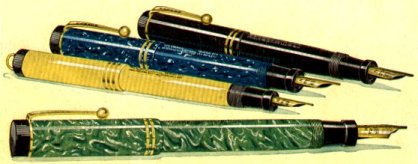
It is kind of intriguing to note that pens of the very sort I was obliged to write with in my school days are being sold today as calligraphy pens, not fountain pens as they were called in my youth. I think that name came from the way ink would cascade in fountains over your fingers, or your books and your lunch when they leaked in your bag. Very satisfying to write with, but I wonder if they have fixed that little anomaly.
Way back in the 1980s, when typing text was just about all you could do on a computer, school teachers were going through a bit of a crisis in the teaching of literacy. They claimed that children got all traumatised if their written work was corrected, so they didn't. There is a generation out there that can barely spell or punctuate. It seemed impossible to convince most teachers to let the kids use these new computer thingies to type their compositions, because they could correct them and end up with clean copy. One teacher of my acquaintance who did use a computer this way claimed that the kids got huge satisfaction out of it, but in those olden days the one class computer had to be severely rationed among the class.
Now that computers can do practically anything and kids wander round with thumb drives on tapes around their necks and every classroom has a smart board, the one thing they do not seem to do is use them for straightforward compositional writing. My granddaughter is a terrible speller, and she was amazed to discover that she could produce a perfect assignment by correcting the spelling on the screen. They can google, they can email, they can rip MP3s, they can edit photos, they can even produce beautifully formatted text work in amazing fonts with clip art, but they don't use the technology simply to help them spell or punctuate.
In the middle ages they recognised that there was a difference between reading and writing literacy. There were people who could read but not write, like Charlemagne and many women. There were scribes who could painstakingly copy out letters and words without much comprehension. That is why they made so many mistakes.
Today we demand high levels of competency at both aspects of literacy, so it would make sense to make use of all the tools at our disposal: pens for learning letter forms and wiring our brains for understanding them; computers for developing fluency, correcting mistakes and encouraging original composition. It couldn't possibly be the case that both sides of the debate could be right, could it?
It is kind of intriguing to note that pens of the very sort I was obliged to write with in my school days are being sold today as calligraphy pens, not fountain pens as they were called in my youth. I think that name came from the way ink would cascade in fountains over your fingers, or your books and your lunch when they leaked in your bag. Very satisfying to write with, but I wonder if they have fixed that little anomaly.
Way back in the 1980s, when typing text was just about all you could do on a computer, school teachers were going through a bit of a crisis in the teaching of literacy. They claimed that children got all traumatised if their written work was corrected, so they didn't. There is a generation out there that can barely spell or punctuate. It seemed impossible to convince most teachers to let the kids use these new computer thingies to type their compositions, because they could correct them and end up with clean copy. One teacher of my acquaintance who did use a computer this way claimed that the kids got huge satisfaction out of it, but in those olden days the one class computer had to be severely rationed among the class.
Now that computers can do practically anything and kids wander round with thumb drives on tapes around their necks and every classroom has a smart board, the one thing they do not seem to do is use them for straightforward compositional writing. My granddaughter is a terrible speller, and she was amazed to discover that she could produce a perfect assignment by correcting the spelling on the screen. They can google, they can email, they can rip MP3s, they can edit photos, they can even produce beautifully formatted text work in amazing fonts with clip art, but they don't use the technology simply to help them spell or punctuate.
In the middle ages they recognised that there was a difference between reading and writing literacy. There were people who could read but not write, like Charlemagne and many women. There were scribes who could painstakingly copy out letters and words without much comprehension. That is why they made so many mistakes.
Today we demand high levels of competency at both aspects of literacy, so it would make sense to make use of all the tools at our disposal: pens for learning letter forms and wiring our brains for understanding them; computers for developing fluency, correcting mistakes and encouraging original composition. It couldn't possibly be the case that both sides of the debate could be right, could it?
Wednesday, May 18, 2011
Literacy Teaching - Again!
My two granddaughters, aged nearly 8 and nearly 11, have just been participating in what are called NAPLAN tests at school. I can't remember what NAPLAN stands for, National something-or-other, but they are basic tests of literacy and numeracy, the basic function of which is to see whether kids across the land are meeting appropriate standards in these subjects. Pretty harmless and sensible, you might think.
Schoolteachers, however, have been whipping themselves into a frenzy of hysteria over it all. Apparently teachers are the only members of the work force who should not be subjected to any kind of scrutiny on the quality of their work. They are also, by their own telling, so naturally dishonest and devious that they very idea that their pupils may be assessed will inevitably cause them to cheat on the testing. And to think that they keep lecturing us on the subject of "values"; a concept dragged into the school lingo by a previous Prime Minister of our fair land who thought that the only people who had any were right wing, avowedly Christian, white males in suits. Ouch, we are getting political; time for a diversion.
The teachers also claim that the tests put incredible stress on the kids. I checked this out with my two, who seemed perfectly cheerful about the whole process. When I asked them if anybody had got upset, they did mention one boy, but he has a habit of throwing stress attacks while playing sport, at birthday parties, and possibly represents a child at the stress laden end of the spectrum. As my older granddaughter has a mode of spelling that would grace Geoffrey Chaucer Hath a Blog, I cannot imagine she will do much for their general score, but she was not in the least stressed about it.
Personally, I think a little stress to achieve does you good. Not that I would advocate beating Latin grammar into the little possums with a birch rod, like they did in the middle ages. It seems a little strange to me that we are so accustomed to literacy and its use in every aspect of what we learn that we find it hard to imagine how much was learned in a non-literate mode in ages past, but we think that assessing the level of literacy that we are achieving poses unacceptable stress. I think there is possibly more stress involved if your deficiencies in the area of literacy only show up at your first job application.
Schoolteachers, however, have been whipping themselves into a frenzy of hysteria over it all. Apparently teachers are the only members of the work force who should not be subjected to any kind of scrutiny on the quality of their work. They are also, by their own telling, so naturally dishonest and devious that they very idea that their pupils may be assessed will inevitably cause them to cheat on the testing. And to think that they keep lecturing us on the subject of "values"; a concept dragged into the school lingo by a previous Prime Minister of our fair land who thought that the only people who had any were right wing, avowedly Christian, white males in suits. Ouch, we are getting political; time for a diversion.
The teachers also claim that the tests put incredible stress on the kids. I checked this out with my two, who seemed perfectly cheerful about the whole process. When I asked them if anybody had got upset, they did mention one boy, but he has a habit of throwing stress attacks while playing sport, at birthday parties, and possibly represents a child at the stress laden end of the spectrum. As my older granddaughter has a mode of spelling that would grace Geoffrey Chaucer Hath a Blog, I cannot imagine she will do much for their general score, but she was not in the least stressed about it.
Personally, I think a little stress to achieve does you good. Not that I would advocate beating Latin grammar into the little possums with a birch rod, like they did in the middle ages. It seems a little strange to me that we are so accustomed to literacy and its use in every aspect of what we learn that we find it hard to imagine how much was learned in a non-literate mode in ages past, but we think that assessing the level of literacy that we are achieving poses unacceptable stress. I think there is possibly more stress involved if your deficiencies in the area of literacy only show up at your first job application.
There has been a little hiatus on updates to the website lately, due to real life interfering with virtual reality, but hopefully I will be adding some new sections soon.
Sunday, December 19, 2010
Reading and Listening
I recently received an email from someone who, as an aside to the main conversation, said he was an Oxford graduate in literature and Classics, but he had read all this literature in modern printed editions. They never discussed the manuscript tradition in those courses.
Now this is a great bugbear of mine. Any modern edition of an ancient work from the manuscript tradition is selected, corrected, disinfected, analysed, annotated and authorised. In many modern definitive editions there is no discussion of where surviving manuscript copies reside, or how many were consulted to produce the edition. Surviving manuscript copies of a work can range from one, as with Beowulf or Sir Gawain and the Green Knight, or several which are each significantly different, as with Piers Plowman, or hundreds with multiple variations, as with the Travels of Marco Polo. Numbers and variants that survive may be serendipitous, but may at least hint at the popularity of a work, and at how much writers and scribes were willing to alter the work in transcription. It is all part of the story of the story, if that makes sense.
There are studies of the variants of certain well known medieval works, some of which are on the web, as this modern medium is more adaptable to production of multiple variants of texts than the old linear string of little black symbols on a page. I seem to have sung this song before. When it comes to written communication, we are going medieval again.
Modern definitive editions have their place,of course. If your Latin or Middle English or Old Slovenian is a bit wonky, it at least gives you access to something you might not otherwise read. But surely literature studies should be looking at how the work has appeared in its various historic guises, at least as part of the consideration of the text. Ah well, I guess I am never destined to be a Professor of Literature!
In the recent collection by Ralph Elliot, which I mentioned a couple of posts ago, he has an article entitled "Chaucer's Voices", in which he discusses various styles of writing in Chaucer as actually representing the patterns of speech of certain types of people. This, he says, is relevant because in Chaucer's day most people knew the stories from having them read aloud to them. In the middle ages, it was reading, whether you did it with your eyes or your ears. Even legal documents often referred to "those who have read or heard" the document in question. This gives another layer of interpretation, through expression or on-the-fly editing. It was those rotten little black printed symbols that gave texts their unvarying character in the first place; handy for the church, but changing the whole nature of literature.
This Christmas, read aloud to somebody, or tell a story. Merry Christmas!
Now this is a great bugbear of mine. Any modern edition of an ancient work from the manuscript tradition is selected, corrected, disinfected, analysed, annotated and authorised. In many modern definitive editions there is no discussion of where surviving manuscript copies reside, or how many were consulted to produce the edition. Surviving manuscript copies of a work can range from one, as with Beowulf or Sir Gawain and the Green Knight, or several which are each significantly different, as with Piers Plowman, or hundreds with multiple variations, as with the Travels of Marco Polo. Numbers and variants that survive may be serendipitous, but may at least hint at the popularity of a work, and at how much writers and scribes were willing to alter the work in transcription. It is all part of the story of the story, if that makes sense.
There are studies of the variants of certain well known medieval works, some of which are on the web, as this modern medium is more adaptable to production of multiple variants of texts than the old linear string of little black symbols on a page. I seem to have sung this song before. When it comes to written communication, we are going medieval again.
Modern definitive editions have their place,of course. If your Latin or Middle English or Old Slovenian is a bit wonky, it at least gives you access to something you might not otherwise read. But surely literature studies should be looking at how the work has appeared in its various historic guises, at least as part of the consideration of the text. Ah well, I guess I am never destined to be a Professor of Literature!
In the recent collection by Ralph Elliot, which I mentioned a couple of posts ago, he has an article entitled "Chaucer's Voices", in which he discusses various styles of writing in Chaucer as actually representing the patterns of speech of certain types of people. This, he says, is relevant because in Chaucer's day most people knew the stories from having them read aloud to them. In the middle ages, it was reading, whether you did it with your eyes or your ears. Even legal documents often referred to "those who have read or heard" the document in question. This gives another layer of interpretation, through expression or on-the-fly editing. It was those rotten little black printed symbols that gave texts their unvarying character in the first place; handy for the church, but changing the whole nature of literature.
This Christmas, read aloud to somebody, or tell a story. Merry Christmas!
Friday, November 05, 2010
John Paston's Books
Recently, when the family medievalist finally abandoned his university office and retired to a study at home, we transported boxes and boxes and boxes of books to a charity which runs secondhand book fairs. We both still have large studies packed to the gunwales with shelves of books. Naturally, in the 15th century when nearly every book was written out by hand, readers and book owners had to be much more selective.
In keeping with my recent trend of putting up on the website examples of horrible messy handwriting of truly interesting content, the last script sample and paleography exercise are a list of books written out by John Paston II in the late 1470s. They comprised his personal library. This funny scrap is part of the famous collection of Paston Letters in the British Library, so it is famous. As well as being in a script that is like cod liver oil, nasty but good for you, it sheds a little light on that whole topic of medieval literacy and the valuation of books. Enjoy it even if you can't read it.
I will get back to the mulberry tree, promise. I'm sure you are as fascinated by it as I am.
In keeping with my recent trend of putting up on the website examples of horrible messy handwriting of truly interesting content, the last script sample and paleography exercise are a list of books written out by John Paston II in the late 1470s. They comprised his personal library. This funny scrap is part of the famous collection of Paston Letters in the British Library, so it is famous. As well as being in a script that is like cod liver oil, nasty but good for you, it sheds a little light on that whole topic of medieval literacy and the valuation of books. Enjoy it even if you can't read it.
I will get back to the mulberry tree, promise. I'm sure you are as fascinated by it as I am.
Thursday, April 29, 2010
Kids, Computers and Literacy Education
Our crackpot government here in Oz has decided to steer us through the rough economic times by putting new buildings in schools, whether they want them or not. This is also supposed to resolve a supposed literacy crisis. After all, buildings teach people to read, don't they? And they keep builders in work. And if the builders are building libraries, then the builders also will undoubtedly become more literate, won't they?
In my granddaughters' primary school they built a new library. The school already had a library in a demountable building, so the government thought that the fair thing would be to take the old one away. It was pointed out to the powers that be that this would hardly be a nett gain for the school, and to avoid adverse publicity in this case and numerous others, they agreed to let them keep it. So then the school had to decide what to do with it. Various suggestions were mooted, including using it as a music room. In the end, they decided to keep it as the library, and to use the new, larger building as a computer centre.
So there will be no increased capacity to store books and other reading materials to increase literacy. And they are confining computers to an oldfashioned enclosed facility just at the time when laptops are becoming affordably cheap and new devices like Kindles, iPads and even phones are making it possible for the computer to be on the classroom desk as part of the equipment of literacy.
It is noteworthy that the kids have lessons in which they learn computing, rather than using computers as tools for learning literacy, numeracy or anything else that can be learned. The old computer lab seems such an 80s concept. Recently my elder granddaughter had a day off school sick, but not so terribly sick. She loves to write but for some reason simply cannot spell. We spent the whole day working on a Powerpoint presentation about Uluru, which they had been set for homework. She had not realised that you can type up your script on a computer, and then correct all the spelling so that it comes out perfect. So what do they do on these computers at school?
I have a horrible feeling that they are learning computing in the same way that some of the less literate early medieval scribes learned writing, copying letters out by sight with little or no understanding of the meaning of what they were writing. Now why didn't the government, instead of buying them a building, buy each of them a laptop and hire some inservice training people to get the teachers up to date with their knowledge of computers and how to fly them? Oh, I forgot. This was not really about education. It was builders that were going to be out of work.
Tuesday, March 02, 2010
National Curriculum and Literacy
Here in Australia we are embroiled in politics over the implementation of a national curriculum for schools. Great idea in theory, generates more heat than light in any attempt at implementation. One of the objectives of the process is to ensure consistent standards of literacy. See previous sentence.
Our Prime Minister, who loves to be photographed with school kids, informed us that he was distressed that a small child he was attempting to commune with did not apparently associate the sounding out of "der o guh" with the written word dog. Therefore all children should be drilled in phonics. Apart from apparently being unaware that a very small child may merely have been a tad overawed by an assertive man in a suit making strange noises at him, it is a little alarming that politicians, who have plenty of other things to do such as making sure that our economy doesn't go down the gurgler, should feel that by such a trivial observation they can set themselves up as experts on the teaching of literacy.
I have just been reading an article by that eminent paleographer Malcolm Parkes ("Which Came First, Reading or Writing?" in Parkes, M. 2008 Their Hands Before Our Eyes Ashgate) in which he discusses the increasing legibility of writing with the introduction of Caroline minuscule. The abandonment of ligatures and the clearly differentiated individual letters meant that the letters of the alphabet became the basic unit of reading, rather than peculiar graphic signs representing whole words. In the terms of the modern debate about literacy, the writers of Caroline minuscule in the 9th century changed from word recognition to phonics. It helped that Latin was a phonetic language, which English isn't.
As the world gradually became more literate, and the methods and purposes of reading and writing changed, the association of script styles and page layout with modes of reading becomes a set of clues to the processes which the brain uses to decode the written word. Wouldn't it be nice if we could get some experts on the history of literacy and writing to engage in the debate on the teaching of literacy in the modern world, rather than relying on simple minded populist politicians' tricks to design the way we educate our kids? Hey, what was that big pink thing going "oink" that just flew past my window.
Monday, August 17, 2009
Medieval Musical Literacy
Many years ago I listened to a lecture from an eminent scholar in which he equated the advancement of the world's knowledge during the course of the middle ages with the volume of manuscript material in the libraries of Europe. Apart from a drastic Eurocentric cultural insensitivity, it expressed an entirely modern concept of knowledge; that it is necessarily written down. Vast amounts of knowledge, especially practical knowledge, were simply not recorded in writing in the medieval period.
Recently I encountered an equally strange academic furphy, in which a musicologist expressed the idea that music in the 10th century was extremely primitive, because the only manuscripts which recorded musical notation displayed only monophonic plainchant. Now this, of course, was not because it was the only music around, but because the monks and clerics of that era were the only people who wrote music down, and what they wrote was the monophonic plainchant used in their offices and rituals. They were of an ascetic turn of mind, in music as in other aspects of life. We have absolutely no idea what wild, complex and exotic music was being produced by the illiterate minstrels who were entertaining the lay population.
We do know that they had a range of instruments in the medieval era, as these have been depicted prolifically in manuscripts, paintings and carvings. They must have played something on them, even though we have no instrumental musical scores. Like so many other aspects of life, they remembered a lot. The use of musical notation became more common, and orderly, in a similar timeframe to the use of lay literacy in reading and writing. But while we may know some old tunes from written sources, we don't know anything about their musical arrangements. In music, as in other areas, it doesn't do to equate written sources with knowledge.
With the increasing enthusiasm for pub sessions among folk muso types and music festival goers, we may be once again going back to the middle ages with more reliance on our ears and memories, and less on little black marks on pages.
Recently I encountered an equally strange academic furphy, in which a musicologist expressed the idea that music in the 10th century was extremely primitive, because the only manuscripts which recorded musical notation displayed only monophonic plainchant. Now this, of course, was not because it was the only music around, but because the monks and clerics of that era were the only people who wrote music down, and what they wrote was the monophonic plainchant used in their offices and rituals. They were of an ascetic turn of mind, in music as in other aspects of life. We have absolutely no idea what wild, complex and exotic music was being produced by the illiterate minstrels who were entertaining the lay population.
We do know that they had a range of instruments in the medieval era, as these have been depicted prolifically in manuscripts, paintings and carvings. They must have played something on them, even though we have no instrumental musical scores. Like so many other aspects of life, they remembered a lot. The use of musical notation became more common, and orderly, in a similar timeframe to the use of lay literacy in reading and writing. But while we may know some old tunes from written sources, we don't know anything about their musical arrangements. In music, as in other areas, it doesn't do to equate written sources with knowledge.
With the increasing enthusiasm for pub sessions among folk muso types and music festival goers, we may be once again going back to the middle ages with more reliance on our ears and memories, and less on little black marks on pages.
Thursday, December 18, 2008
Kids, Fonts, Multimedia and Reading
Those who have been following my ramblings, both on the Medieval Writing website and here, know that I have a thing about trying to understand the process of literacy, and also about how modern literate communications are becoming more medieval in style than the plain linear texts that my generation learned from. These two themes came together for me recently when I attended my primary school age granddaughters' school presentation and got a copy of their school magazine.
The first notable thing was how savvy the kids were at incorporating multimedia into their live presentations. Text was incorporated into video, slide shows and live performance with lots of fancy special effects, with interesting references to much grander productions. I'm not sure what George Lucas would have made of their pinching not only the Star Wars theme music, but the receding scrolling graphics for the introduction to a blooper sequence of all the things that went wrong when they entered an interschool push car challenge. The whole production was a bit of community theatre worthy of a medieval mystery play, without the risk of the scenery catching fire.
The school magazine had lots of snippets of their original writing. Now when I was a pup, we wrote our stuff out with a pen, and the school secretary typed it out onto Gestetner sheets (Ask your grandmother about those!) and it was printed in glorious grainy black and white in a standard typewriter font. In this magazine, each kid had chosen their own font, colours, decorative headings and artwork. Each work was not just a text, but a visual exploration of design. They had made great efforts to make it appropriate, and some were quite witty. One kid had written a poem about Google, all in the Google sequence of colours for the letters. It's going back to something that is conceptually quite close to the techniques employed in a medieval manuscript. Literacy crisis - bah, humbug!
I recently obtained a copy of the second edition of Mary Carruthers The Book of Memory, a wonderful work that explores how various techniques, including page design, were used to help medieval scholars remember huge swags of text in a meaningful manner. It's a marvellous book, if a bit of a heavy read, and emphasises that reading and memory, text and image were not opposites, but part of a fuller, richer experience of literacy. I must sit down and read it thoroughly, if I can just remember where I put it down last.
The first notable thing was how savvy the kids were at incorporating multimedia into their live presentations. Text was incorporated into video, slide shows and live performance with lots of fancy special effects, with interesting references to much grander productions. I'm not sure what George Lucas would have made of their pinching not only the Star Wars theme music, but the receding scrolling graphics for the introduction to a blooper sequence of all the things that went wrong when they entered an interschool push car challenge. The whole production was a bit of community theatre worthy of a medieval mystery play, without the risk of the scenery catching fire.
The school magazine had lots of snippets of their original writing. Now when I was a pup, we wrote our stuff out with a pen, and the school secretary typed it out onto Gestetner sheets (Ask your grandmother about those!) and it was printed in glorious grainy black and white in a standard typewriter font. In this magazine, each kid had chosen their own font, colours, decorative headings and artwork. Each work was not just a text, but a visual exploration of design. They had made great efforts to make it appropriate, and some were quite witty. One kid had written a poem about Google, all in the Google sequence of colours for the letters. It's going back to something that is conceptually quite close to the techniques employed in a medieval manuscript. Literacy crisis - bah, humbug!
I recently obtained a copy of the second edition of Mary Carruthers The Book of Memory, a wonderful work that explores how various techniques, including page design, were used to help medieval scholars remember huge swags of text in a meaningful manner. It's a marvellous book, if a bit of a heavy read, and emphasises that reading and memory, text and image were not opposites, but part of a fuller, richer experience of literacy. I must sit down and read it thoroughly, if I can just remember where I put it down last.
Subscribe to:
Posts (Atom)