Contributors

Saturday, March 26, 2016

Literacy: Words and Pictures: The Index

  Just another list of previous blog posts on a theme. I guess it ties the books/paleography and the material/culture/heritage strands together. That's my story and I'm sticking to it.


And to illustrate the concept here is this amazingly retro gif from when gif meant grungy old monochrome picture, not video of cats pole vaulting.

Medieval History and Modern Literacy A first inchoate thought.
English 4 U The language never did stand still.
Text, Image, Manuscript and Multimedia About padded lamp posts in London.
Medieval Musical Literacy Oh, and music.
National Curriculum and Literacy Dianne goes off about the ignorance of politicians again.
Writing and Remembering Did medieval readers remember more stuff?
Kids, Computers and Literacy Education Dianne goes off about ignorant politicians yet AGAIN.
Reading and Listening Reading with your ears, medieval style.
Eeee! Books About the e-book hysteria. Postscript: Why is Kindle still not any good?
Literacy Teaching - Again! I did get a little wound up about this topic around then.
Literacy through Mouse or Quill? She's at it again.
Books Online or Online Books? Bit philosophical here. Is a book a thing or a concept?
Angels Ain't Angels Reading a stained glass window on the nine orders of angels.
Corporal Acts of Mercy Reading another medieval text, in stained glass and wall painting.
Medieval Literacy: Pictures and Text More about the art of reading a story in pictures.

Sunday, March 20, 2016

Gotta Love Antiquarians

  The other day I was excavating some archaeological deposits in a bottom drawer and found some yellowing notes I had taken years ago from William Stukeley's Itinerarium curiosum. I had completely forgotten I had taken them. It was a while ago and I got distracted for a decade or so. Sometimes real life gets in the way of your cyberlife. I have a bit of a passion for antiquarian writers and illustrators. They tend to be looked down on a bit by academic historians of the serious serious scholarly variety because of their eclectic magpie style of collecting random information and some lack of rigour in checking it, not to mention their fondness for dodgy etymologies, genealogies, intricacies of heraldry, corporation minutes recorded in endless detail, scandalous doings of the aristocracy, and their penchant for putting little historical treasures into their pockets.
  The point is, they saw things at a particular time and from the mindset of that time. They saw things that have gone. Their perceptions of particular eras of the past are different to our own. When you read them, you are not just looking at the past, but at past perceptions of the past.
  Many of their works are now hard to come by, or were, until the Internet Archive started reproducing them in some numbers. Farewell interlibrary loan slips and visits to rare book rooms. Hello antiquarian world delivered to my desktop.


  At the simplest level they can show you what something looked like when it looked different to the way it does now, as with this picture of Beverley Minster with a little dome over the crossing, from C. Hiatt 1898 Beverley Minster, an Illustrated Account of its History and Fabric: London.This is reproducing an engraving that was old when the book was published.


  They can show you things that are not able to be seen any more, as with this grave slab of an abbot from the long disappeared Meaux Abbey near Beverley, from G. Poulson 1840 The History and Antiquities of the Seigniory of Holderness ... Vol.2: Hull. This work describes various relics that were located in farm buildings near the abbey site at the time.


  Urban renewals of the 19th century resulted in the removal of many picturesque, but probably uncomfortable and unhygienic, dwellings, changing the whole appearance and sense of the town environment. This example was once in Boston, from Pishey Thompson 1856 The History and Antiquities of Boston: Boston and London.


  Some public buildings or monuments of a town have been demolished, such as this market cross at Harewood, from J. Jones 1859 History and Antiquities of Harewood: London. This is quite symbolic of the changing status of the place from a small market town to a village that could be moved holus bolus out of the country estate at the whim of the local landowner.


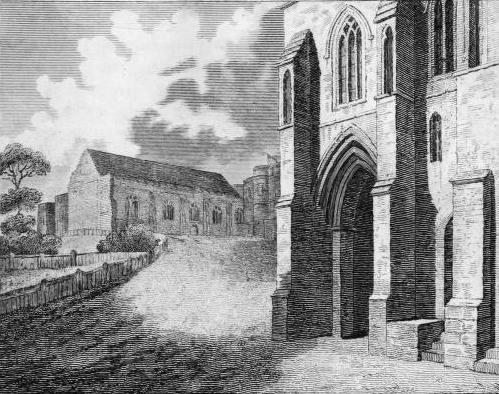
  They can strip away the modern urban clutter and give you a different sense of how the spaces in a town worked, as in this picture of the Westgate and castle hall at Winchester, from J. Milner 1809 The History, Civil and Ecclesiastical and Survey of the Antiquities of Winchester, Vol.2: Winchester.
  No, they are not photographs, they are interpreted pictures. Actually photographs can be quite interpretive too. The engravings follow certain conventions, like inserting rustic yokels with livestock into every scene with a derelict old building and often exaggerating the ruinousness of ancient sites for romantic effect. These in themselves convey something of the attitude of the writers and illustrators, working within their own time and space, to not only the remains, but the historical era they came from.
  The words they wrote also reveal their attitudes to the eras they describe. I am not looking for some ultimate historical truth here, but how the perception of an era, and the perception of places within a certain era, is built up in multiple layers as ideas develop, alter, get refuted, get reinvigorated. The events of history are reflected in patterns on the ground, in the design of towns, in the shapes of the countryside. The attitudes to history are reflected in the words and pictures used to describe them.
  The antiquarians are providing a link between two projects which I started as multimedia projects long ago, with an emphasis on visual evidence; an examination of the way John Leland saw the country and places in it immediately after the Reformation when much religious urban infrastructure was torn down or allowed to moulder away, and a view of how modern towns of medieval origin reflect their past, even as they incorporate modern urban institutions into their fabric. Actually, the antiquarians are not so much a link as part of a weave of historical and contemporary observations over time.


  To celebrate my discovery of my Stukeley notes, and the fact that the Internet Archive has a facsimile of his book, he has been incorporated into my Flickr Tour of Boston. The engraving above shows the famous church towering over a scruffy little town with a wooden bridge over the river. He describes it as a place much decayed, its warehouses shut down and various buildings demolished. He describes little antiquities he has found (and palmed) and repeats bits of antiquarian gossip he has acquired.
  These Flickr tours are my work in progress, as I turn a mountain of decomposing slides and early prehistoric scans of same into a useful data bank, excavate old material from Word files extracted from obsolete multimedia file formats using an old computer that had to be given periodic offerings of mammoth meat to keep it going until the job was done, and swap crayola graphics for Google earth pictures and the like. It may all make sense one day. Feel free to browse the Flickr Collection of Leland Tours, but don't expect it to look like a big picture for a long time yet. This is called working in public.
  Meanwhile, under the Stukeley notes was another set from a book by one William Bray who went touring around, mainly in Derbyshire and Yorkshire, publishing his observations in 1783. Heading north through Yorkshire he refers to "and other hills in the horizon, on one of which the White Mare of Weston Cliff, or White Stone Cliff, is visible on a clear day" In a footnote he explains "A mark in a hill, like the White Horse in Berkshire, Whiteleaf-cross in Bucks etc." Now the current wisdom claims that the white horse of Kilburn, located on Whitestone Cliff where it can be seen when travelling from York to Thirsk on the A19, was created in 1857 by a local schoolmaster, with the help of his pupils, because he didn't see why they should only have hill figures down south.

Image by Tony Wells, via Wikimedia Commons
  
  So what did William Bray see? Was there some sort of precursor to this figure there? Did the local schoolteacher have some knowledge of something that used to be there, but wasn't any longer? You can always find surprises in antiquarian books. 
  Next stop the two Williams, Stukeley and Bray, will be visiting Leicester. And there might be some new tours of little places of no great complexity, until I get the rest of the raw material in order.
  I always hated Dickens in high school, mainly, I think, because our dopey teachers tried to present it as high art rather than jolly ripping yarns. Not so long ago I went back and read The Pickwick Papers. The ever so important Mr Pickwick and his gang of wandering buffoons are a wonderful, joyful send up of these folks rambling around the countryside looking at stuff, then giving talks to each other about it, not to mention getting into all manner of scrapes and japes. Even back then some of these folks were considered to be amusing. We should be grateful for their curiosity.

Sunday, March 13, 2016

Cultural Heritage

    I expect This section to grow as I plough through my photograph collection. Of course tombs are cultural heritage, as are the remains I discuss while touring with Leland, not to mention manuscripts, but these are for the observations that don't fit into those categories.


Manuscripts and Stained Glass What is stained glass for?
Not Just a Big Church An introduction to medieval religious communities and the traces they have left. More to come on this.
Heritage Sites: Trendy and Not Trendy Why we should look for our history in some less glamorous places.
Gotta Love Antiquarians A celebration of antiquarian writers and illustrators and what we can learn from them.
Where Did the Stones Go? A meandering wonderment on the fate of the stones of vanished buildings.
Visual History: Magnifying Glass or Fun Fair Mirror? A bit of a ramble on the art of seeing in a historical context.

Saturday, March 12, 2016

Medieval Manuscripts and Paleography

  Medieval manuscripts and paleography were what this blog was originally about, but this has got a bit swamped lately with some other themes. My website Medieval Writing still seems to be used, and I get some interesting feedback from users, despite the fact that it is becoming technologically aged. Here are some of the posts that people have found interesting.


Web Sites and Medieval Manuscripts Something I thought in 2006. Wonder if it still holds good.
Medieval Manuscripts on the Move Digitisation of manuscript collections has come a long way since 2007.
Classification of Scripts Yes, I still have radical ratbag views about script classification in paleography.
Manuscripts and Information Control A whole bunch of people have been devoting their efforts to medieval marginalia since I wrote this.
Why Paleography Sucks Never do irony on the web. 
Disappearing Paleography From the days when you got blog post comments from interested participants, not just snake oil salesmen and spivs.
Writing and Remembering One of those random thought bubbles I should try to retrieve some time.
Not That Voynich Manuscript Again NEVER mention the V****** M********* in any forum on the internet.
Horrible Old Handwriting Merovingian minuscule in this case. It's not all about the pretty stuff.
Gothic Book Hands Gothic Book Hands. Pointer to section on Medieval Writing website.
Special English Characters Another pointer.
1066 and All That Dianne has bitch attack about historical periodisation, and another pointer to post Conquest Old English writing.
Of Tennis Balls and Mulberry Trees Pointer to script example of Gothic cursive from a very strange manuscript fragment.
John Paston's Books Pointer to paleography exercise on John Paston's book list in the British Library.
History of the Familiar Pointer to history of humanistic minuscule.
It's Personal Wee note on a medieval autograph.
Dirty Medieval Books Pointer to interesting work by Kathryn Rudy. For some reason a lot of people have clicked on this. Hope they were not disappointed.
Monastic Pressmarks Monastic pressmarks. Pointer to section of website on them.
Glossed Bible Pointer to a bit of interesting medieval detritus.
Little French Things Pointer to script sample of 14th century French cursive.
You Want Vinegar With Your Oak Galls? My most viewed blog post ever. If any subject arouses passion and commitment it is the correct formulation for iron gall ink.
The Writing of the Illiterate Lombards More irony, Lombardic minuscule, and more iron gall ink.
Shoes and Ships and Sealing Wax Pointer to website section on seals.
Medieval Recycling Pointer to script sample of French cursive on a document recycled into a book wrapper.
Boring Jobs and Bizarre Coincidences Hufnagelschrift.
Medieval Documents Medieval documents. Pointer to website section on dealing with them.
What Not To Do With Your Manuscripts Pointer to website section on manuscript conservation.
Manuscripts and Naked Hands The great white gloves controversy.
Medieval Digimania The ever changing status of digitised medieval manuscripts on the web.
When Did Latin Become Dead? Pointer to website sample of scramboozled 16th century English and Latin.
Ferocity of Iron Gall Ink That stuff again, and how it consumes itself.
Vale Notice of passing of Malcolm Parkes.
Ever Wonder What Paleographers Do? The Getty knows.
Working Script for (Somewhat) Ordinary Books French batarde.
Blockbuster Epic Resource for Paleographers and Historians Dictionary of Medieval Latin from English Sources. Think it's now up on the web as well.
Colophons and Marginalia and All That Colophon and gloss to the Lindisfarne Gospels.
Irish Gospels Insular minuscule.
Bored with Gothic? Try This. Beneventan minuscule.
Sweet Caroline Caroline minuscule.
Protogothic and Choking Lions Protogothic.
Beasties from the Bestiary Gothic textura, with animals.
It's Gothic Jim, But Not As We Know It That totally weirdshit script from the Luttrell Psalter.
Magdalen in Blue Gothic rotunda.
Hoccleve on Chaucer Gothic bastarda
Flyleaf Friday. Or When is a Manuscript Finished? On adding prayers to books of hours.
Notarial Signs Notarial signs.
Medieval Graffiti and Medieval Marginalia Ponderings on scratchings in the margins of life.
Cutting Up Manuscripts Why you shouldn't cut up manuscripts, and why people did.

Travelling with Leland

  This is an occasional series I am putting together, trying to look at the England that the 16th century antiquarian, John Leland, saw immediately after the English Reformation and compare it to what we can see today. As it goes along with a massive project of updating my digital photography collection, for too long sadly neglected, it may totter along slowly. Each post links to a Flickr album which is annotated with the observations of Leland and assorted later travellers and antiquarians. 


A Little Experiment in Medieval Beverley My favourite little Yorkshire town. I lived nearby for two longish stints. It is famous for its two spectacular churches, but the marks of its history can be found in obscure corners and overgrown spaces. Nearby is an important Cistercian abbey that has completely disappeared.
Another Medieval Day Trip - Pickering, Yorkshire A little town on the edge of the North York Moors with a church full of 15th century wall paintings and a splendid motte and bailey castle.
Imagining Medieval Leicester Leicester has to be one of the most unappealing places to go medieval hunting. Everything is so chopped about and major traffic routes separate everything from everything else. If you don't get killed crossing the road, you can put the medieval town back together again.
A  Medieval Tour of Higham Ferrers A tiny town packed with medieval treasures, mercifully just out of range of the industrial sprawl of the Midlands.
A Medieval Tour of Boston (Lincolnshire) A splendid church, a little gem of a guildhall, a scrap of friary and a tumbledown tower house; pretty much all that survives of a prospering late medieval port town.
Leland in Hidden East Yorkshire East Yorkshire was a thriving area in the middle ages, but just sort of faded away over time. This tour looks at the once busy ports of Hull and Hedon (pronounced Ooll and Eddon if you need to ask directions) and surrounding villages.
The Hidden East Yorkshire That Leland Forgot Actually, the Holderness area at the mouth of the Humber is the hidden East Yorkshire that everyone forgets. There is a splendid church at Patrington, but the rest is battered relics. And some of it has fallen into the sea.

  So we will eventually progress from here. The Yorkshire wolds are full of treasures from many ages. York itself is a major enterprise. I expect this to potter along in somewhat random fashion around the country as a whole, but I think that's what Leland did himself.

Medieval Tombs : The Index

  As the medieval tombs series is trundling along to infinity, it seems smart to put in an index page for it. I am doing the same for some of my other themed posts.


What's With Medieval Tombs?
1. Introduction. What it says on the tin, with particular reference to the concept of liminality and its codification in the medieval Christian concept of purgatory.
2. Knights. An introduction to the depiction of knights on effigy tombs and how they embody the liminal state of death.
3. Oddments. A ramble around styles of tombs other that three dimensional effigies: brasses, incised slabs, floriated crosses and other non-effigy tombs.
4. Cadavers. An exploration of a style of tomb which seems a bit weird to the modern mind; the depiction of the deceased as a decomposing corpse.
5. Royalty. A tour of the tombs of the trendsetters of mortuary fashion, with some surprising observations.
6. Clergy. An introduction to the particular characteristics of the depiction of members of the clergy on tombs.
7. Civilian Males. Social changes meant that not everyone who could afford a fancy tomb was entitled to a suit of armour. Here are some examples of what else gave you status in the later middle ages.
8. Isolated Alabasters. A tour of the amazing collection of alabaster tombs in Harewood church, and what questions they raise about population, society, historical identification and the meaning of life.
9. The Process of Death. All about how medieval funerary commemoration was not an event but an extended process, including what sometimes happened with the bodies.
10. Heraldry on Tombs. The significance of the use of heraldry, often quite lavishly, on tombs.
11. Low Relief and Half Sunk Effigies. While many effigies fit into very stylised and recognisable classes, there are some unusual variants, although they do fall into a class of their own.
12. The Aesthetics of Armour. How practical changes to armour made effigies of knights ever less beautiful.
13. Female Fashion. In the 14th and 15th centuries fashion became a thing, reflected in minute detail in the tombs of ladies.
14. What Happened to Them During the Middle Ages. Not all the destruction of tombs was due to Henry VIII's henchmen, iconoclasts and puritans. It can be argued that they had built in obsolescence from the start.
15. Children on Medieval Tombs. Dead children were rarely commemorated on medieval tombs, and when they do appear there they may not even have been dead at the time.
16. Memorials in Glass. Stained glass windows could also serve as funerary memorials in various ways.
17. Identification and Dating. Some tricks, traps and anomalies in identifying those commemorated on tombs.
18. Animals on Tombs (1). First part of a look at how animals are depicted on tombs and what they signify.
19. Animals on Tombs (2). More about animals on tombs and how to do a rebus.
20. Owning the Church. About competition and claiming of church spaces
21. Brass Rubbings - Perfect Facsimiles? How brass rubbings have changed the way we see monumental brasses.
22. Bling on Tombs

  This page will continue to grow as I meander through this theme. Might eventually even end up with something.


Saturday, March 05, 2016

What's With Medieval Tombs? Part 17: Identification and Dating

  One of the things that people always seem to want to know about medieval tomb effigies is who they represent. I guess that's natural curiosity, although I'm more inquisitive about what they represent. We know that with a few rare exceptions from the very top of the social scale, the effigies on medieval tombs, stone, alabaster or brass, were not personal portraits. They have a tendency to have identikit faces and body types. Personal identifiers were added on in the form of inscriptions or heraldry.


  Some tombs, particularly brasses like the one above to Thomas de St Quintin in Harpham church, Yorkshire, have a neat inscription. These follow a couple of pretty standard formulae in which the person is named, their status indicated and their date of death supplied, as well as requests for prayers for their soul. Not all brasses had inscriptions and not all that were in existence have survived. Surviving inscriptions on three dimensional effigy tombs are more rare, although they may have once had painted inscriptions that have been scrubbed off over time. Some tombs have a marginal indentation that was for a brass inscription that was inlaid around the figures, but these have often vanished. Brass was removed and flogged off in great quantities, including entire effigies, as evidenced by the numbers of worn indents lying unidentified in church floors.


  This tomb of a priest in Blyborough, Lincolnshire has an incised inscription in stone around the border of the tomb slab. That is an unusual survival, and pretty much sorts that one out, as with the brasses bearing inscriptions. It also displays the other main identifier, heraldry. Unfortunately heraldry, like inscriptions, was often painted on to the shields on tombs and more often than not has been effaced.


  This once splendid but now rather beat up alabaster tomb in Swine, Yorkshire has heraldic shields borne by lively and demonstrative angels, but the designs have utterly disappeared.
  In the days before effigy tombs were a thing, before the 14th century, it was not usual for tomb slabs to have inscriptions and certainly not dates. The cross slabs found tucked away in odd corners of churches are evidence for this.


  The above shows an assortment of battered tomb slabs propped against the wall of the church at Blyth in Nottinghamshire. The fact that these generally have no personal identifiers and are so often stacked in odd spots, obviously not in their original location, suggests that they may never have been meant as permanent memorials to individuals. Rather, they may have been part of the extended funeral process; reminders to pray for the most recently departed and help them get to wherever they were going. 
  The appearance of inscriptions, and particularly dates, on tomb monuments coincides approximately with the appearance of written dates on legal documents. Charters of around the 12th century were usually not dated, as they were regarded as recordings of witnessed oral testimony. The witness list was more significant than the precise date.


  This late 12th century charter (British Library, add. charter 70691) records a grant of land by an individual, Ralph de Cuningburgh, to Byland Abbey. It is ratified by his seal, which is a very generic kind of knight on funny looking horse seal without complex armorials, typical of its era. There is an extensive witness list but no date.
  During the 13th and 14th centuries there were changes in the format of, and attitude to, legal documents, including the regular use of dates, sometimes in quite elaborate forms. It can be seen as a shift in the conception of the document from a note of an oral process to being a literate process in its own right, requiring formal writing and archiving for posterity. It also locates the doings of an individual in time and place.
  Heraldry itself became more elaborate over the 14th and 15th centuries, developing into an intricate code which could be read to identify and memorialise a individual and place them within their family history. A heraldic tomb was a family archive, not just a reminder to pray for an individual. Seals and tombs developed similar types of complexity.
  The development of effigy tombs with individually identifiable heraldry and inscriptions took place over the same general time frame, and in some ways reflect similar changes of mindset. The tomb becomes uniquely identifiable, readable, and possibly gains a greater expectation of becoming a more permanent memorial. The tomb becomes a personal record.
  Unfortunately time plays havoc with the aspirations of mere mortals. Tombs have been moved, reorganised, carted out into the churchyard and dragged back again, assembled in new combinations, scrubbed of colour and identity, destroyed in great numbers in times of religious discord and generally reduced to chaos. It all makes identification difficult.


  For example, this handsome late 15th century alabaster knight in the church at Halsham, Yorkshire, is lying on a brass indent that clearly does not belong to him. We don't know who it belongs to because the brass is gone. Remedievalising damaged old churches has created a few of these concoctions. An earlier post on the alabaster tombs of Harewood described the movements of the tombs around the church and the reattribution of their identities.
  Antiquarians who pottered around the countryside recording things, often in great detail, and then had them published in strange old tomes, have noted inscriptions that have become lost or misplaced since. Their books were once difficult to get hold of if you didn't live near the right libraries, but their increasing appearance on the wondrous Internet Archive means there are treasures there for the fossicking.
  Another documentary source for the identification of tombs is through the wills of those commemorated. Unfortunately the tortuous process of searching through medieval wills combined with the massive and random nature of losses of medieval tombs means that it is not very often that these can be matched up. And of course, whether the provisions in the will were ever carried out depended on the executors.
  So the identification of tombs tends to rely mostly on the intersection of two lines of best fit; who were the likely contenders as lords of the manor or other prominent citizenry, or were known to be rectors of a church or bishops or suchlike known and named ecclesiastics, and what was the date of the tomb as estimated stylistically. These can lead to some circular processes of reckoning, and there are traps.
  Armour underwent rapid and readily recognisable changes over the period when effigy tombs became the thing to have, so knightly effigies can be dated by folks who have an intimate knowledge of the minutiae of these changes.


  For example chain mail and long surcoats with big shields predates chain mail and long surcoats with smaller shields and leather knee protectors, as with these two chaps in the Temple church, London. Rowel spurs replace prick spurs.


  The more bits of plate that appear and the shorter the surcoat gets, the further you travel through the 14th century. This example is from Bedale, Yorkshire.


  By the early 15th century the knight is encased like a tortoise in plate and wears his sword belt jauntily low slung across his hips. This example is from Barmston in Yorkshire.


  By the late 15th century it has acquired hinged flappy bits and the knee, elbow and shoulder protectors look too big and clunky to be real. This brass is in Howden church, Yorkshire.
  It looks simple enough but there are some questions. Did the armour represent what the deceased actually wore or was it the latest fashion when the tomb was produced, which was sometimes before the commemorated person's death and sometimes after? (The answer is bleeding obvious in the first of those scenarios but not the second.) If somebody chose to commemorate a progenitor to boost the perception of their lineage a bit, or were even a little tardy in commemorating a deceased relative because they were busy beating up the French for a few years, did they get him bespoke carved in retro gear or just take an off the shelf model in whatever was fashionable at the time? Is the monument actually in its original church? Some are known to have been moved from monastic churches at the Dissolution (but not if they were buried under car parks). Were monuments moved for other reasons, like a village becoming deserted, for example? Similar questions can be asked over the use of livery collars for dating.


  Lancastrian SS livery collar in Harewood church.


  Yorkist suns and roses collar in Harewood church. Do these represent an absolute date when the dynasties changed over, or do they represent the loyalties and affinities of the departed? It seems to be assumed that nobody would dare to be commemorated, or have their progenitors commemorated, in the livery of the opposition to the current monarch. We can't be quite sure exactly what statement they were trying to make.
 Similar doubts apply when using the very rapidly changing vagaries of ladies' fashion of the 14th and 15th centuries as identifiers. Even an intimate knowledge of individual workshop styles may tell you more about the craftsmen and the effigy than about the person commemorated. It is possible to date an effigy within a certain range of error, but probably there are too many variables to make a positive identification of an individual in many cases.
  Identification of individuals can be hampered by the lack of precise contemporary genealogical information from the days when survival of personal documents could be a bit variable.


  This snippet is from one of my favourite personal treasures. It is a very scrappy genealogy on paper written and annotated in the 16th century in various hands, of a branch of the Beauchamp family, related to the famous ones of Warwick, which died out in the male line in the 16th century. My guess is it was somebody's working notes on sorting out the family estate. This branch of the family was not very imaginative about names and there was a succession of them called Walter Beauchamp. For those not comfortable with abominable 16th century cursive, this entry is annotated "some say this man is too much". In other words, the writer is not quite sure how many Walter Beauchamps there were. Lesser knightly and gentry families were likely to be even less well documented.


  So finally, here we have a tomb slab in Aldborough church, Yorkshire, which has had all of its identifying features removed. It was once a rather unusual brass, combining the floriated cross cum tree of life motif with an inscription and a plethora of heraldry. It has novelty with tradition, family pride with anonymity. It is in a little village built over a Roman town with a maypole on the village green, a village cross commemorating a battle against the Scots and a line of megalithic stones up the road. Individual identities blend into the stories of places and the rise and fall of societies. It's the best we can all hope for.

Saturday, February 27, 2016

Medieval Literacy: Pictures and Texts

  I have recently been plodding through organising, optimising and recataloguing a large number of digitised slides of the stained glass of York Minster. I spent quite a bit of time in York and managed to photograph a fair swag of the city's magnificent medieval glass, but I didn't have a cherry picker or a drone so there is a fair bit of fiddling about with enlarging details and seeing if they come out. Also my identification of the individual windows was not quite as accurate as it might have been. So with the trusty Pevsner and a pile of other reference books on the desk, I am putting Humpty Dumpty together again.
  The process has jogged the brain into mulling over the whole question of the nature of medieval literacy and the old chestnut about church art being the Bible of the illiterate. For starters, literate and illiterate do not need to be polar opposites. Medieval people read what they needed or wanted to read, whether it was their own names, the oft repeated prayers and psalms in their books of hours, their household accounts, the texts of sermons they were about to deliver, or complex philosophical treatises requiring knowledge of several languages. The same applied to writing. Some scribes copied stuff literally, some made notes from the spoken word, some specialised in formulaic legal documents and some authors wandered round dictating their thoughts to hapless secretaries.


  York Minster is a big building, with very tall windows filled, in many cases, with fiddly detail, especially the 14th century windows with multiple small panels full of colour. It's very hard to simply read the windows without any background or prompts. A photograph like the one above of a window in the north side of the nave gives a bit of an idea of what you actually see. Who is doing what up there and why does the window seem to be hung about with little golden bells?


  The window in question was, in fact, donated by the bellfounders. A telephoto lens shows a kneeling donor presenting the window to St William of York himself, and he is bestowing his blessing on the bellfounders. This panel is at the bottom of the window so it is easier to make out than some, but medieval folks did not have telephoto lenses. No doubt people were told the story of the bellfounders and their donation, and all those little bells just reminded them of it.


  Something similar must apply to the windows which tell the stories of morality and martyrdom and the episodes of the Bible. In peering at the images trying to tell which window was which, I found myself searching for those visual clues that permeate every visual retelling of the story, because for all the variations of style and medium, medieval church art used a standard repertoire of symbols to represent each story. The window above tells the story of St Catherine of Alexandria.


  The episodes of the life of St Catherine are played out in a series of pictures which follow the story exactly as it is told in the Golden Legend. The panels are detailed, even after centuries of damage and restoration, but quite far away. These stories would have been known to the lay congregation mainly from oral teaching. Not too many folks would have had a copy of Jacobus de Voragine in their personal library, but they would have heard the stories many times. They would also have seen the stereotyped images of saints in their books of hours or prayer books, if they were so fortunate as to have one. They learned the stories, recognised the imagery and could follow the sequences in the art in the church. Is this literacy or illiteracy? I say it is a form of literacy. Word and image reinforced each other in medieval books, as well as on windows and walls.


  The story of St Catherine is told in exactly the same type of strip cartoon form on the nave wall of Pickering church in Yorkshire. It was an accepted way of narrating and imaging a well known story. The philosophers, the prison, the flogging, the wheels and the grand finale with the beheading with a sword: that tells the story. You read it.


  The nave clerestorey windows are way, way up. The top row of scenes are actually 12th century glass from an older cathedral on the site, but they must have thought it was worth saving. What the hell is it? Ah. That was a clue. On the right there is a great big mouth with chompy teeth with people going into it. Other panels seem to have people being poked into a pot.


  Hell is what it is. At one time pictures of the Last Judgement were all over the chancel arches of many churches, possibly most. There they were large and easy to see, and were no doubt explained in gruesome detail by some of the more charismatic preachers. Literate or illiterate, the basic clues tell the story.


  In the formerly Benedictine church of Blyth the Doom painting is faded and battered, but it was big and conspicuous in its heyday.


  The nasty demons poking people into hell were suitably demonic. The whole image is a story which can be read, not just a picture. Benedictine monks were not illiterate. They could read those little black marks scratched on to pages, but pictures could be read as well. Even if you could just make out the big chompy teeth in the distant window, you were reading the story. 


  Even a single figure is not just an image, but represents a story. St Christopher carrying the baby Jesus across a river is one of the more dubious bits of Christian mythology, but it was a story popularised in the Golden Legend and he is one of the most prolifically illustrated saints. This is a 15th century example from the windows of York Minster, but while the size and boldness of the 15th century glass makes the image easier to see from the ground, the story has to have been learned. 


  In the parish church at Easby the founding myth of the Jewish and Christian religions is depicted on the wall. It is read from left to right, just like writing. It is a story that was codified and solidified by being written down, then copied and recopied. It can be read in the Bible, or in excerpts, or in paraphrase, or in pictures. Or it can be learned by listening. Bible picture books were produced for wealthy aristocratic patrons in which the stories were paraphrased with words and pictures. They were for literate people, but literate people used pictures too. Literate clerics used historiated initials to help them find particular passages in their psalters or lectionaries, because the iconographic code had rules and conventions, just as writing did.


  So trying to identify exactly which window I'm looking at is very analogous to how a medieval person might read that window. What is that panel in the middle? Man looking over left shoulder, somewhat startled, at an angel in the sky, with sheep wandering about.


  Joachim in the wilderness. Back story to the life of the Virgin and the early life of Jesus. Christian mythology known from the Golden Legend, filling out some unsatisfactory gaps in the Gospels. The window tells the story. You just have to know how to read it.


  Upside down saint. Martyrdom of St Peter. Now what else can we recognise to see what story this window is telling?


  Kings in vegetation. Jesse tree. Genealogy of Christ. From the York Minster choir but originally from New College, Oxford, where we can presume the congregation was reasonably literate.
  We may regard many medieval folks as less literate than ourselves, but in many ways they may have been more literate, with minds open to different ways of telling stories.