Our giant bookfair has come and gone, quashing the idea that the printed book has had its day. $430,000 dollars made for Lifeline in one three day weekend flogging secondhand books, CDs, records and games and puzzles. Some kinds of books are less alive than others. It seems that fewer people want to buy paper dictionaries these days. Well, why would they I guess? They seem to be following in the wake of encyclopaedias, which plenty of people want to give away, but nobody wants to buy. It's all on the internet.
They do want to buy lots of other kinds of books to hold in their hands and turn the pages. Kindle editions and other e-books might be making some inroads, but people still want something to put on the shelf. Classic English literature sold well, even though all the titles are available in e-books for free. Apart from the touchy feely thing, I wonder if the deficiencies in the capability to properly reference cheap e-book editions is keeping student of Eng. Lit. still hunting for cheap paper versions.
Meanwhile, back in the land of pixelated manuscripts, I have recommenced updating graphics and reformatting pages. Yawn!!! When I get totally bored with this, I will reveal to you a tantalising scrap of bookbinder's waste which shows just how bad legal Latin was becoming by the 16th century.
Saturday, March 24, 2012


Saturday, March 03, 2012
To Hell with Technology
Well there I was, chugging through updating the graphics and formatting in the script samples, when I came upon a section where I had no master graphic files in any format known to modern computing. They must have been some of the earliest examples that I had done, probably from before Medieval Writing was even a website. So there has been a slight delay while I rescanned a whole bunch of images of protogothic and Gothic documents and catalogued them. All done now, so the Gothic documents are now being updated again. The fact that it is raining like Noah's fludde this weekend might mean some more progress gets made. Can't do any gardening without a boat. To think that with fancy modern technology, images become unreadable in a few years, but those original 500 year old scratches on parchment are still there and legible.
Friday, February 24, 2012
Books Online or Online Books?
I have mentioned in the past that I do some voluntary work in a large warehouse that processes secondhand books for several bookfairs a year to raise funds for the charity Lifeline, a telephone counselling service. All the books are donated by members of the public in Canberra (which is, of course, the capital city of Australia). Naturally, current changes to the way books are published and read is a perennial topic of discussion among the volunteers, as this affects our bottom line. It has occurred to me that there is a distinct time lag between technological changes to books and the concept of a book.
Because we receive unselected donations, we cannot sell all the books. Some are too decrepit or damaged, too out of date or simply appear in too many duplicates, so some books have to go to paper recycling. This upsets some people, as it seems that they still have a mindset that a modern printed book is like a medieval manuscript; a unique artifact and repository of knowledge. Most, in fact, are mass produced items of the industrial age. Everybody does keep a look out for books that are rare or especially interesting, so that they get special treatment.
Now that e-books are infiltrating the world of reading, we wonder what effect this will have on the buying public. There are those among us who use our e-book readers for certain purposes, in my personal case for recreational reading, but who are definitely not abandoning our reference libraries of real books any time soon. The likes of Amazon.com and ABE books have increased our personal reference libraries of real books through online sales. On the other hand, Google books and The Internet Archive have expanded our reference collections to include old and rare titles that we would otherwise find very difficult to acquire. Some folks feel that a book should have a cover and pages, just like a medieval manuscript. Others are coming to the idea of a book as a concept; a bounded body of information or themes or ideas, even if it does not exist as a thing.
Our bookfair is moving with the times by introducing online sales of real books (Lifeline Canberra Online Bookstore). It is just at the beginning of operations so far and the number of books is currently limited, but we hope it will grow to cater for the internet savvy crowd who still like real pages. That might keep us going until somebody works out how to sell used conceptual books in the form of secondhand e-books.
We also sell music in the form of records and CDs. One lady dropped us off a whole box full of CDs, saying her husband didn't need them any more as he had ripped them all to his iPod. My first thought was, hang on, don't you keep the CDs as backups? I guess I think of musical performances as objects rather than concepts, and musical performance objects have only been around for about one hundred years, unlike reading objects. Now there is a thought for further philosophical rumination.
Because we receive unselected donations, we cannot sell all the books. Some are too decrepit or damaged, too out of date or simply appear in too many duplicates, so some books have to go to paper recycling. This upsets some people, as it seems that they still have a mindset that a modern printed book is like a medieval manuscript; a unique artifact and repository of knowledge. Most, in fact, are mass produced items of the industrial age. Everybody does keep a look out for books that are rare or especially interesting, so that they get special treatment.
Now that e-books are infiltrating the world of reading, we wonder what effect this will have on the buying public. There are those among us who use our e-book readers for certain purposes, in my personal case for recreational reading, but who are definitely not abandoning our reference libraries of real books any time soon. The likes of Amazon.com and ABE books have increased our personal reference libraries of real books through online sales. On the other hand, Google books and The Internet Archive have expanded our reference collections to include old and rare titles that we would otherwise find very difficult to acquire. Some folks feel that a book should have a cover and pages, just like a medieval manuscript. Others are coming to the idea of a book as a concept; a bounded body of information or themes or ideas, even if it does not exist as a thing.
Our bookfair is moving with the times by introducing online sales of real books (Lifeline Canberra Online Bookstore). It is just at the beginning of operations so far and the number of books is currently limited, but we hope it will grow to cater for the internet savvy crowd who still like real pages. That might keep us going until somebody works out how to sell used conceptual books in the form of secondhand e-books.
We also sell music in the form of records and CDs. One lady dropped us off a whole box full of CDs, saying her husband didn't need them any more as he had ripped them all to his iPod. My first thought was, hang on, don't you keep the CDs as backups? I guess I think of musical performances as objects rather than concepts, and musical performance objects have only been around for about one hundred years, unlike reading objects. Now there is a thought for further philosophical rumination.
Sunday, February 05, 2012
More Medieval Documents
I have just made some additions to the section on Dealing with Medieval Documents, having discovered that I had left out some stuff I had meant to put in originally. Does that mean that web publishing is more forgiving, and therefore a good thing, or that it just makes web authors absent minded and disorganised, which is a bad thing?
Friday, February 03, 2012
What Not To Do with Your Manuscripts
Latest additions to the site include a small expansion to the section on Handling Manuscripts, having come across some more little bits that have been mishandled.


Take a look at these two images and try to work out what has been going on here, before going to the website to find out. Then when you have found out, do not do it to any little treasures of your own.
I have also made a slow new beginning to the process of updating the graphics and formatting in the Script Samples section, having made a start on protogothic documents.
I have also made a slow new beginning to the process of updating the graphics and formatting in the Script Samples section, having made a start on protogothic documents.
Sunday, January 15, 2012
Medieval Documents
I have just put up a brief section on the website on Dealing with Medieval Documents. This is in response to a steady trickle of emails that I get about the reading of such documents. It is aimed at the beginner in the field, so if you are already calendaring the medieval archives of Lord Poodlewumpus or researching a new theory on 14th century Lithuanian diplomatic, you don't need to read it. It is my first little step into the new year updates. I will get back to the dull but worthy job of updating the graphics and formatting soon. And I must fossick out something interesting from my collection of medieval detritus to add something new to the site. Oh yeah, and I have to get back the the mulberries. Rats!
Sunday, January 08, 2012
Back, or Forward, to Hieroglyphics
Many years ago when multimedia was a novelty and the world was young and innocent, twelve year old multimedia designers told us that the written word, in terms of alphabetic spelling, was going to become extinct. We were told that the more intuitive mode of communication for hypertext links and task initiation was in the use of graphic symbols; pictograms or ideograms, although young multimedia designers were unfamiliar with these terminologies. They called them graphic hot links back then.
As a middle aged fogey back then, as opposed to the geriatric fogey that I am now, I begged to differ. After all, what is so intuitive about a quasi-3D button on a 2D screen and what is so intuitive about doing everything by pressing buttons anyway? My granddaughters would not understand this now, and their opposable thumbs are developing whole new skills and functions. I compromised and wrote captions on my buttons in my alphabetic dogmatism.
Nonetheless, I fail to see what is so intuitive about a picture of a rabbit running across the bottom of the screen as a navigation symbol for the next page, or about a cartoon dog fetching items from a letterbox as an email link. Furthermore, the use of graphics shaped like electrical switches is not intuitive, it is merely utilising learned symbolic communication from older technology. Besides, I can never work out which is on or off anyway since they changed real switches from little levers that pointed up or down to rocker switches with a vertical line and a circle on them. These are ideograms in their own right, but not particularly intuitive.
I think it was because the web started off as a text based medium that restored text links to respectability, even though it is now filled with everything that whistles and sings. Drop down menus had words on them, even if menu shortcut bars had symbols on them. We went back to believing in alphabetic writing for a while.
I have noticed a recent return to graphic symbolism, but the symbols have become even more simplified and abstract. Gmail now has strange little monochrome graphics instead of headings that say "trash", "archive" or "label". I have to hover the mouse over them to make the words come up in order to know which is which. My antique Kindle (nearly a year old!) has real buttons which say "menu" and "home" and the like, while my husband's new one has buttons with strange little symbols which all look like little geometric grids, indistinguishable one from the other without a good light and reading glasses. We are going back to pictograms, but they do not have the essential characteristic of being readily distinguishable.
Intriguingly, as technologies change, the pictograms themselves are becoming increasingly abstracted. The standard graphic symbol for "save", for example, is a picture of a floppy disk, which many younger users of computers may never have even seen. The pictogram of a floppy disk has transformed into an ideogram for saving a file to whatever medium is being used. The garbage can symbol for trash is well recognised, but I always used to panic when using a Macintosh because to eject a removable medium, you had to drag it to the trash. The learning part of my brain recognised this as merely a process, while the intuitive part always panicked that I was trashing the contents of the medium and my files would all disappear. Mind you, with Windows I had a mental problem with clicking the "start" button to turn it off, but they have fixed this now as the button has no misleading captions, just that annoying little quadripartite flag, which is neither informative nor intuitive but merely an arrogant brand recognition symbol. Is this simplifying onscreen communication, or making the language of the process more complex and subtle?
On other technological gizmos, real live buttons are no longer the simple analogue for binary function that they used to be. Gadgets get smaller, so rather than fill up space with loads of buttons, a few buttons perform different functions when used in different combinations. To remember how to work these permutations and combinations we have to read the manual. Back to ye olde alphabetic writing again, and yet I remember when it was considered that operating manuals, whether for gadgets or computer software, should be quite unnecessary. The more graphic and intuitive it gets, the more we need the words.
Old books about writing put these various schemes on a timeline of increasing conceptual complexity; pictograms, ideograms then alphabetic writing. We are actually using a combination of all three today, which some would say is the death of proper writing, but I think may represent a whole new complex of mental decoding of symbolic language.
So why am I rabbiting on about this stuff right now? Well, just to keep you amused and to deflect attention from the fact that updates to Medieval Writing may be a few weeks off yet, as we are in school holidays down here and that means extensive visits from granddaughters, and besides, I am just in the process of buying a new fishing kayak.
As a middle aged fogey back then, as opposed to the geriatric fogey that I am now, I begged to differ. After all, what is so intuitive about a quasi-3D button on a 2D screen and what is so intuitive about doing everything by pressing buttons anyway? My granddaughters would not understand this now, and their opposable thumbs are developing whole new skills and functions. I compromised and wrote captions on my buttons in my alphabetic dogmatism.
Nonetheless, I fail to see what is so intuitive about a picture of a rabbit running across the bottom of the screen as a navigation symbol for the next page, or about a cartoon dog fetching items from a letterbox as an email link. Furthermore, the use of graphics shaped like electrical switches is not intuitive, it is merely utilising learned symbolic communication from older technology. Besides, I can never work out which is on or off anyway since they changed real switches from little levers that pointed up or down to rocker switches with a vertical line and a circle on them. These are ideograms in their own right, but not particularly intuitive.
I think it was because the web started off as a text based medium that restored text links to respectability, even though it is now filled with everything that whistles and sings. Drop down menus had words on them, even if menu shortcut bars had symbols on them. We went back to believing in alphabetic writing for a while.
I have noticed a recent return to graphic symbolism, but the symbols have become even more simplified and abstract. Gmail now has strange little monochrome graphics instead of headings that say "trash", "archive" or "label". I have to hover the mouse over them to make the words come up in order to know which is which. My antique Kindle (nearly a year old!) has real buttons which say "menu" and "home" and the like, while my husband's new one has buttons with strange little symbols which all look like little geometric grids, indistinguishable one from the other without a good light and reading glasses. We are going back to pictograms, but they do not have the essential characteristic of being readily distinguishable.
Intriguingly, as technologies change, the pictograms themselves are becoming increasingly abstracted. The standard graphic symbol for "save", for example, is a picture of a floppy disk, which many younger users of computers may never have even seen. The pictogram of a floppy disk has transformed into an ideogram for saving a file to whatever medium is being used. The garbage can symbol for trash is well recognised, but I always used to panic when using a Macintosh because to eject a removable medium, you had to drag it to the trash. The learning part of my brain recognised this as merely a process, while the intuitive part always panicked that I was trashing the contents of the medium and my files would all disappear. Mind you, with Windows I had a mental problem with clicking the "start" button to turn it off, but they have fixed this now as the button has no misleading captions, just that annoying little quadripartite flag, which is neither informative nor intuitive but merely an arrogant brand recognition symbol. Is this simplifying onscreen communication, or making the language of the process more complex and subtle?
On other technological gizmos, real live buttons are no longer the simple analogue for binary function that they used to be. Gadgets get smaller, so rather than fill up space with loads of buttons, a few buttons perform different functions when used in different combinations. To remember how to work these permutations and combinations we have to read the manual. Back to ye olde alphabetic writing again, and yet I remember when it was considered that operating manuals, whether for gadgets or computer software, should be quite unnecessary. The more graphic and intuitive it gets, the more we need the words.
Old books about writing put these various schemes on a timeline of increasing conceptual complexity; pictograms, ideograms then alphabetic writing. We are actually using a combination of all three today, which some would say is the death of proper writing, but I think may represent a whole new complex of mental decoding of symbolic language.
So why am I rabbiting on about this stuff right now? Well, just to keep you amused and to deflect attention from the fact that updates to Medieval Writing may be a few weeks off yet, as we are in school holidays down here and that means extensive visits from granddaughters, and besides, I am just in the process of buying a new fishing kayak.
Wednesday, December 14, 2011
A Blogological Mystery
One of the strangest things about this blog is that the most read post by a country mile is a simple Christmas greeting I put up last year, which included the information that I had fixed a problem in the font size of some older postings. Now why do so many people want to read that?
I can understand the passion about oak gall ink. After all, that is a topic to set anybody's pants on fire. A grumpy sneer at the wannabe English aristocracy is bound to be either mildly amusing or irritating to a number of people. I hope all the folks who tuned in to read about dirty medieval books were not disappointed that it was about greasy finger marks. And it is intriguing that people seem to be still reading an old posting from ages ago about shorthand. The disappearance of paleography from the English academic scene may be of interest to educational curmudgeons like myself. And there are always people interested in antique writing technology.
Anyway, this is just a Christmas greeting. Merry Christmas, and best wishes for whatever seasonal festivities you celebrate in your part of the world among your people. My New Year's resolution is to finish all the technical updates to Medieval Writing, not to mention tidying up unfinished sections, and to provide some groovy new goodies. I will, truly. Next year.
I can understand the passion about oak gall ink. After all, that is a topic to set anybody's pants on fire. A grumpy sneer at the wannabe English aristocracy is bound to be either mildly amusing or irritating to a number of people. I hope all the folks who tuned in to read about dirty medieval books were not disappointed that it was about greasy finger marks. And it is intriguing that people seem to be still reading an old posting from ages ago about shorthand. The disappearance of paleography from the English academic scene may be of interest to educational curmudgeons like myself. And there are always people interested in antique writing technology.
Anyway, this is just a Christmas greeting. Merry Christmas, and best wishes for whatever seasonal festivities you celebrate in your part of the world among your people. My New Year's resolution is to finish all the technical updates to Medieval Writing, not to mention tidying up unfinished sections, and to provide some groovy new goodies. I will, truly. Next year.
Monday, November 07, 2011
Who Spotted My Deliberate Mistake?
After receiving an email from somebody who wanted some information about Charlemagne's monogram, I discovered that I had left out a piece of the transcription in the paleography exercise of a Carolingian diploma, and nobody has told me about it. I'm sure you were all too polite to mention it, rather than never noticed.
For all those quill pen freaks out there, I have put a little picture of a page where the pen went wrong in the Quill Pen section. Just a triviality to show that medieval manuscripts were not all perfect.
And I'm still formatting and tidying up stuff.
For all those quill pen freaks out there, I have put a little picture of a page where the pen went wrong in the Quill Pen section. Just a triviality to show that medieval manuscripts were not all perfect.
And I'm still formatting and tidying up stuff.
Tuesday, October 25, 2011
Hurray for Brewster
I have grumped before about the ephemeral nature of the web, and now I am going to grump again. I have just upgraded the graphics and formatting for the script samples for formal diplomatic hands, most of which are papal documents. I had not gone into these in great detail as the Vatican Secret Archives website used to have a really good, extensive section on The Diplomatics of Papal Documents. It has apparently disappeared. It can be found on The Internet Archive here, so all is not lost.
 I can understand that some older web material might look a bit olde worlde after a few years. After all, that is why I am upgrading my own stuff. Some material is ephemeral or topical by nature. But when somebody (or somebodies) has taken the trouble to produce work which is of enduring interest, even if minority interest, and of educational value, and otherwise hard to come by, and very attractive to boot, why would you just remove it? I mean, when a paper book exhausts its print run, the existing books are still out there. When a website is gone it is gone. Well it would be, were it not for Brewster and The Internet Archive. May he and his mighty project live forever.
Friday, October 21, 2011
Authentic Fakery
Every so often I get an email from somebody who wants to buy, or has bought, a bit of medieval memorabilia on eBay and wants to know whether they are getting good value. Note that I do not answer these queries; that is, I answer the emails but not the question. Everybody has their own idea of good value, and I am not a qualified valuer. Besides, I just might be bidding against them. One writer did once venture the opinion that all medieval manuscripts on eBay were fake. I could not imagine who would take the trouble to produce an authentic looking piece of medieval manuscript fakery for the sort of money that they generally get on eBay. There are 19th century calligraphic pieces in medieval style, but if it looks like a duck and quacks ........
An item currently for sale has me intrigued. It is a carved and gilded book cover which is advertised as being a modern fake in 15th century style, produced by a well known forger in Siena. It seems that, so far, nobody wants to buy it. Is it because, the object having been identified as a fake, that it is difficult to identify or authenticate that it is the particular fake that it is purported to be? A quick google around art auction websites suggests that fake book covers by this particular forger can fetch several thousand English pounds. He apparently produced a lot of book covers based on some in the city archives in Siena. A known fake painting by the artist was sold to over twenty thousand pounds.
So what is an authentic fake? Does a fake eventually generate its own authenticity? Is a fake of less value if you cannot authenticate the identity of the faker?
Meanwhile, back at the coal face, the update to graphics and formatting of the script samples of all Gothic book hands is complete and I am about to start on the document hands. Yippee!
An item currently for sale has me intrigued. It is a carved and gilded book cover which is advertised as being a modern fake in 15th century style, produced by a well known forger in Siena. It seems that, so far, nobody wants to buy it. Is it because, the object having been identified as a fake, that it is difficult to identify or authenticate that it is the particular fake that it is purported to be? A quick google around art auction websites suggests that fake book covers by this particular forger can fetch several thousand English pounds. He apparently produced a lot of book covers based on some in the city archives in Siena. A known fake painting by the artist was sold to over twenty thousand pounds.
So what is an authentic fake? Does a fake eventually generate its own authenticity? Is a fake of less value if you cannot authenticate the identity of the faker?
Meanwhile, back at the coal face, the update to graphics and formatting of the script samples of all Gothic book hands is complete and I am about to start on the document hands. Yippee!
Friday, October 14, 2011
Rejected, Discarded, Forgotten
Have you checked out the blog Forgotten Bookmarks? It's all about the odd things that people leave in secondhand books. If you have ever bought secondhand books, you have probably found some yourself: restaurant menus, newspaper clippings, postcards, notes and annotations. They are little stories in themselves.
I found a very unfortunate one the other day, while sorting for the monster secondhand book fair. It was in a guide to writing fiction, the book itself inscribed from one female person to another with "Follow your dreams". The insert was a publisher's rejection letter. It seems the would-be author chucked out the book, the letter and her dreams all together. Very sad.
Have you ever wondered what happened to failed medieval authors? Did they just quietly starve, or get themselves a desk job in the town guild or the chancery? How did you get to be an author anyway, apart from getting yourself locked away for a number of years by your country's enemies in a reasonably comfortable prison with nothing to do? For every Geoffrey Chaucer or Thomas Hoccleve, were there dozens of government scribes whose colleagues ducked out to the privy when they saw them approaching with yet another manuscript in their hands? For every William of Malmesbury or Matthew Paris, were there dozens of monks being ordered to stop scribbling and get to choir immediately? We only have winner's history, even in the literary area.
Upgrades to the scripts in Medieval Writing have got as far as Gothic bastarda. Sounds promising, but that is only the book scripts.
I found a very unfortunate one the other day, while sorting for the monster secondhand book fair. It was in a guide to writing fiction, the book itself inscribed from one female person to another with "Follow your dreams". The insert was a publisher's rejection letter. It seems the would-be author chucked out the book, the letter and her dreams all together. Very sad.
Have you ever wondered what happened to failed medieval authors? Did they just quietly starve, or get themselves a desk job in the town guild or the chancery? How did you get to be an author anyway, apart from getting yourself locked away for a number of years by your country's enemies in a reasonably comfortable prison with nothing to do? For every Geoffrey Chaucer or Thomas Hoccleve, were there dozens of government scribes whose colleagues ducked out to the privy when they saw them approaching with yet another manuscript in their hands? For every William of Malmesbury or Matthew Paris, were there dozens of monks being ordered to stop scribbling and get to choir immediately? We only have winner's history, even in the literary area.
Upgrades to the scripts in Medieval Writing have got as far as Gothic bastarda. Sounds promising, but that is only the book scripts.
Wednesday, October 05, 2011
Right Royal Books
I have just received an email suggesting that I remind you all about the exhibition of manuscripts from the Royal collection at the British Library. This exhibition will display some of their splendiferous treasures from one of their oldest, and most prestigious, collections. The British Library website has an announcement for the exhibition here. There is not much information at that site yet, but presumably there will be more when the exhibition opens in November. There has also been a continuing series of postings on the exhibition, the collections and the associated activities on the British Library blog Medieval and Earlier Manuscripts. Let us hope that once the exhibition is underway, they are generous with what they put online, for those of us who cannot just pop over to London for the live event.
Saturday, October 01, 2011
So Many Books!
After five days of lugging books around and a week of entertaining two rampaging granddaughters, progress has resumed on updating the formatting and graphics in the script sample section of Medieval Writing. I am now into Gothic textura book hands. Wheeeeee!
The book fair I was helping at is a truly amazing thing. It started many years ago in a modest way, and has grown continually, so now they can run two main fairs a year, and supply a number of smaller ones in other places, in an absolutely enormous building with over 200,000 books laid out on rows of tables. All books have been donated by the Canberra community. It is, I believe, the biggest book fair in Australia.
The organisers of the fair are themselves somewhat perplexed by the continuing growth of the event, and are wondering just what will happen in the future. More books are being donated, and at the same time more books are being bought, but can it continue? Possibly some of the growth in donations can be attributed to the demographics of Canberra, a city that has been populated by young professional people who are now becoming older retired professional people. Many are probably at a downsizing stage, not to mention a departing stage.
The buying public is still turning up to recycle the books, however, so reports of the demise of the printed book are currently a little premature. There are some interesting things to note. Fiction turns over at a great rate. I think more people actually buy books, then recycle them, rather than borrowing from libraries. Classic literary fiction does not sell all that well. Perhaps the free downloads of out of copyright material, or purchases for a few cents from Amazon of such works in Kindle format, are the making the first inroads in the e-book department. Then again, perhaps everybody is sick to death of Jane Austen. Personal prejudice there.
I will be interested to see how the whole thing progresses over the next few years, I should get a close view, as I have been persuaded to continue helping by sorting and pricing dictionaries and thesauruses and the like. Now those are books where you still need to riffle the pages.
The book fair I was helping at is a truly amazing thing. It started many years ago in a modest way, and has grown continually, so now they can run two main fairs a year, and supply a number of smaller ones in other places, in an absolutely enormous building with over 200,000 books laid out on rows of tables. All books have been donated by the Canberra community. It is, I believe, the biggest book fair in Australia.
The organisers of the fair are themselves somewhat perplexed by the continuing growth of the event, and are wondering just what will happen in the future. More books are being donated, and at the same time more books are being bought, but can it continue? Possibly some of the growth in donations can be attributed to the demographics of Canberra, a city that has been populated by young professional people who are now becoming older retired professional people. Many are probably at a downsizing stage, not to mention a departing stage.
The buying public is still turning up to recycle the books, however, so reports of the demise of the printed book are currently a little premature. There are some interesting things to note. Fiction turns over at a great rate. I think more people actually buy books, then recycle them, rather than borrowing from libraries. Classic literary fiction does not sell all that well. Perhaps the free downloads of out of copyright material, or purchases for a few cents from Amazon of such works in Kindle format, are the making the first inroads in the e-book department. Then again, perhaps everybody is sick to death of Jane Austen. Personal prejudice there.
I will be interested to see how the whole thing progresses over the next few years, I should get a close view, as I have been persuaded to continue helping by sorting and pricing dictionaries and thesauruses and the like. Now those are books where you still need to riffle the pages.
Monday, September 19, 2011
Slight break in Transmission
Updates to Medieval Writing have hit a slight delay. Sometimes real life has a habit of interfering with the tranquility of virtual reality. You see, it started with a fire and explosion in a chemical factory. No really. Let me explain.
The family medievalist, now he is retired, helps out at a charity called Lifeline which offers telephone counselling. He doesn't do that, but does help with their major fundraising effort, two gigantic secondhand book fairs each year. This involves sorting books for six months and then selling them over a three day fair, which is occurring next weekend.
But there was a fire and explosion in a chemical factory in the suburb where the books are stored and nobody could get in for several days, so they couldn't move the books to the place where they sell them last weekend, when there are young and able bodied volunteers available to move and unpack them. So they are having to move and unpack 200,000 books over the next few days with a team of aged retired warriors. I took pity and offered to help. Books are heavy you know. Maybe there is something in this e-book thing after all.
Add to that the usual level of chaos in the family circle, and there might be a few little delays, but I will get back on the job. Sorry if this sounds like a "dog ate my homework" story. More updates coming eventually.
The family medievalist, now he is retired, helps out at a charity called Lifeline which offers telephone counselling. He doesn't do that, but does help with their major fundraising effort, two gigantic secondhand book fairs each year. This involves sorting books for six months and then selling them over a three day fair, which is occurring next weekend.
But there was a fire and explosion in a chemical factory in the suburb where the books are stored and nobody could get in for several days, so they couldn't move the books to the place where they sell them last weekend, when there are young and able bodied volunteers available to move and unpack them. So they are having to move and unpack 200,000 books over the next few days with a team of aged retired warriors. I took pity and offered to help. Books are heavy you know. Maybe there is something in this e-book thing after all.
Add to that the usual level of chaos in the family circle, and there might be a few little delays, but I will get back on the job. Sorry if this sounds like a "dog ate my homework" story. More updates coming eventually.
Monday, September 12, 2011
By Gode's Bludde, Forsooth!
BSL, just when I thought Geoffrey Chaucer Hath a Blog was the silliest medieval oriented thing on the web, I find out about this. I received an email from an anonymous private secretary to the Lord of Kinterbury requesting permission to link to my website if I would link in return to The Ancient and Medieval Honour Guild. Now Medieval Writing is entirely public and anybody can link to it. Feel free. But his Lordship's little effort is only accessible, apart from a few entry screens, to persons who can prove they are descended from medieval knights and who hold a manorial title such as Lord or Lady, and they are dedicated to the highest moral ideals of chivalry etc. Well, that last is a good thing, but I wonder whether it extends to chivalric attitudes to the descendants of jugglers and criminals, recent immigrants to Olde Englande and other diverse members of the human race.


I mean, are they really still like that in England? I do remember when I was living there at some stage in the past there was talk about reform to the House of Lords, and a peer of the realm was arguing quite genuinely on TV that he was one of the people who should be leading the country because he had a hedge on his estate that dated to Anglo-Saxon times. They dutifully showed a picture of the hedge, and I couldn't believe my little Aussie ears.
I suppose the private secretary didn't know he was writing to a lefty, pinko, socialist, republican Australian descended from miscellaneous bods who had fled their motherlands to live in a country where they were not subjected to anachronistic, feudal-descended attitudes. I answered him quite politely. I think.
PS. In relation to recent postings on this blog, the header of said site is illustrated with a picture of some ye olde distressed parchment and a modern fountain pen which has leaked blobs all over it. I invite learned iconographic analysis of this imagery.
Tuesday, September 06, 2011
Boring Jobs and Bizarre Coincidences
I am plodding resolutely through updating the formatting and graphics in the script samples section of Medieval Writing. This may drive me bonkers, but I guess it is a good thing to do. I have worked my way into the protogothic section. That still leaves an awful lot. There still seem to be plenty of people making use of the site, so it shouldn't look too aged and daggy (unlike its author). I have discovered that some of the examples that I put up fairly early in the piece not only have sad little graphics, but I was also still experimenting with how to present transcriptions and the like. I guess it will come out rather more consistent eventually. I have lots of new stuff to put up, but I am (currently) maintaining steely resolve to tidy up the backlog.
An odd distraction came up during the week, when somebody in England sent me a picture of a page of a manuscript that they had had in their possession for twenty years or so to ask me some questions about it. It was a liturgical sheet on paper with musical notation in the form of German hufnagelschrift. The odd thing was that it seemed to be an exact match in every way with a leaf I had acquired only a few months ago from the USA; not identical of course - it was a manuscript - but identical in script, notation and every decorative detail.

She emailed the dealer I had bought mine from, and he was equally sure that it was from the same manuscript as the one from which he had sold several leaves. There is nothing odd about the way manuscript leaves from the same book have fluttered around the world, having been split up and passed around at auction and through dealers. It does seem a large coincidence that they should be randomly reunited by email across the world.
The conversation we had, which involved references to various German websites displaying liturgical manuscripts, was reminiscent of several others I have had in which people somehow want their treasures to be older than they seem to be, and then claim that they have got the oldest whatever-it-is in captivity. Now I think paleographical dating may be a tad overrated, but I do think you go on some sort of Occam's razor principle. Or in modern parlance, if it quacks like a duck, waddles like a duck and swims like a duck it probably is not a highly advanced pterodactyl. Just mentioning it in case you think you have the earliest whatsit in the world in your little bottom drawer.
An odd distraction came up during the week, when somebody in England sent me a picture of a page of a manuscript that they had had in their possession for twenty years or so to ask me some questions about it. It was a liturgical sheet on paper with musical notation in the form of German hufnagelschrift. The odd thing was that it seemed to be an exact match in every way with a leaf I had acquired only a few months ago from the USA; not identical of course - it was a manuscript - but identical in script, notation and every decorative detail.

A bit of mine
She emailed the dealer I had bought mine from, and he was equally sure that it was from the same manuscript as the one from which he had sold several leaves. There is nothing odd about the way manuscript leaves from the same book have fluttered around the world, having been split up and passed around at auction and through dealers. It does seem a large coincidence that they should be randomly reunited by email across the world.
The conversation we had, which involved references to various German websites displaying liturgical manuscripts, was reminiscent of several others I have had in which people somehow want their treasures to be older than they seem to be, and then claim that they have got the oldest whatever-it-is in captivity. Now I think paleographical dating may be a tad overrated, but I do think you go on some sort of Occam's razor principle. Or in modern parlance, if it quacks like a duck, waddles like a duck and swims like a duck it probably is not a highly advanced pterodactyl. Just mentioning it in case you think you have the earliest whatsit in the world in your little bottom drawer.
Friday, August 19, 2011
Surging Forward into the Past
Having spent a good deal of time rescanning old photos and reorganising my photographic collection of medieval manuscripts, I have begun the process of updating some of the more manky old photos in the script examples section of Medieval Writing, as well as reformatting, updating links and all that jazz. This will take some time, so be patient and we might get there in time for the next great leap in the digital revolution.
However, there are a few points for users to note. If the photographs are larger and less compressed, they will take longer to load. If you are still running on a windup clockwork modem, please be patient. I cannot turn scans from black and white photographs in old books into living high definition technicolor. I cannot make the script in the photographs more legible than it is in the original manuscript. I cannot remove difficulties like flaws in the vellum, stains on the page, or writing visible from the other side of the page, nor should I try. These are the difficulties you encounter in the real live world of manuscripts.
I am not going to rescan the sets of alphabet letters. I had a number of discussions with colleagues right at the beginning of the project about the use of alphabet sets. Personally I think people just carry them around and stick them under their pillow rather than use them effectively if they are available. That is why they are all on rollovers so you can't just print them as sets, not, as one correspondent suggested, that I think you might steal them. Hey, you can have them. They're yours. I actually think it works better to hunt for the letters in context, but I included the separate letters so as not to cause palpitations among the troops. But I'm not doing them again.
Somewhere along the way I will get tired of all this reinventing, and sneak in some new stuff from the increasing piles around me. Meanwhile, have fun with it.
However, there are a few points for users to note. If the photographs are larger and less compressed, they will take longer to load. If you are still running on a windup clockwork modem, please be patient. I cannot turn scans from black and white photographs in old books into living high definition technicolor. I cannot make the script in the photographs more legible than it is in the original manuscript. I cannot remove difficulties like flaws in the vellum, stains on the page, or writing visible from the other side of the page, nor should I try. These are the difficulties you encounter in the real live world of manuscripts.
I am not going to rescan the sets of alphabet letters. I had a number of discussions with colleagues right at the beginning of the project about the use of alphabet sets. Personally I think people just carry them around and stick them under their pillow rather than use them effectively if they are available. That is why they are all on rollovers so you can't just print them as sets, not, as one correspondent suggested, that I think you might steal them. Hey, you can have them. They're yours. I actually think it works better to hunt for the letters in context, but I included the separate letters so as not to cause palpitations among the troops. But I'm not doing them again.
Somewhere along the way I will get tired of all this reinventing, and sneak in some new stuff from the increasing piles around me. Meanwhile, have fun with it.
Thursday, August 11, 2011
Literacy through Mouse or Quill?
A few weeks ago there was a tiny flutter in the media as a "research" project was published that purported to show that children gain better written literacy when they learn to write with a pen, having to form the letters themselves, than when they type on a computer. The one little trouble with this piece of research was that it was backed by a company that makes pens. OK, calm down pen guys. Even those of us who do most of our composing on a keyboard still have plenty of use for pens. And yes, handwriting can be a very satisfying art. Platoons of calligraphers cannot be wrong.
It is kind of intriguing to note that pens of the very sort I was obliged to write with in my school days are being sold today as calligraphy pens, not fountain pens as they were called in my youth. I think that name came from the way ink would cascade in fountains over your fingers, or your books and your lunch when they leaked in your bag. Very satisfying to write with, but I wonder if they have fixed that little anomaly.
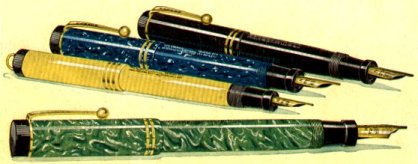
Way back in the 1980s, when typing text was just about all you could do on a computer, school teachers were going through a bit of a crisis in the teaching of literacy. They claimed that children got all traumatised if their written work was corrected, so they didn't. There is a generation out there that can barely spell or punctuate. It seemed impossible to convince most teachers to let the kids use these new computer thingies to type their compositions, because they could correct them and end up with clean copy. One teacher of my acquaintance who did use a computer this way claimed that the kids got huge satisfaction out of it, but in those olden days the one class computer had to be severely rationed among the class.
Now that computers can do practically anything and kids wander round with thumb drives on tapes around their necks and every classroom has a smart board, the one thing they do not seem to do is use them for straightforward compositional writing. My granddaughter is a terrible speller, and she was amazed to discover that she could produce a perfect assignment by correcting the spelling on the screen. They can google, they can email, they can rip MP3s, they can edit photos, they can even produce beautifully formatted text work in amazing fonts with clip art, but they don't use the technology simply to help them spell or punctuate.
In the middle ages they recognised that there was a difference between reading and writing literacy. There were people who could read but not write, like Charlemagne and many women. There were scribes who could painstakingly copy out letters and words without much comprehension. That is why they made so many mistakes.
Today we demand high levels of competency at both aspects of literacy, so it would make sense to make use of all the tools at our disposal: pens for learning letter forms and wiring our brains for understanding them; computers for developing fluency, correcting mistakes and encouraging original composition. It couldn't possibly be the case that both sides of the debate could be right, could it?
It is kind of intriguing to note that pens of the very sort I was obliged to write with in my school days are being sold today as calligraphy pens, not fountain pens as they were called in my youth. I think that name came from the way ink would cascade in fountains over your fingers, or your books and your lunch when they leaked in your bag. Very satisfying to write with, but I wonder if they have fixed that little anomaly.
Way back in the 1980s, when typing text was just about all you could do on a computer, school teachers were going through a bit of a crisis in the teaching of literacy. They claimed that children got all traumatised if their written work was corrected, so they didn't. There is a generation out there that can barely spell or punctuate. It seemed impossible to convince most teachers to let the kids use these new computer thingies to type their compositions, because they could correct them and end up with clean copy. One teacher of my acquaintance who did use a computer this way claimed that the kids got huge satisfaction out of it, but in those olden days the one class computer had to be severely rationed among the class.
Now that computers can do practically anything and kids wander round with thumb drives on tapes around their necks and every classroom has a smart board, the one thing they do not seem to do is use them for straightforward compositional writing. My granddaughter is a terrible speller, and she was amazed to discover that she could produce a perfect assignment by correcting the spelling on the screen. They can google, they can email, they can rip MP3s, they can edit photos, they can even produce beautifully formatted text work in amazing fonts with clip art, but they don't use the technology simply to help them spell or punctuate.
In the middle ages they recognised that there was a difference between reading and writing literacy. There were people who could read but not write, like Charlemagne and many women. There were scribes who could painstakingly copy out letters and words without much comprehension. That is why they made so many mistakes.
Today we demand high levels of competency at both aspects of literacy, so it would make sense to make use of all the tools at our disposal: pens for learning letter forms and wiring our brains for understanding them; computers for developing fluency, correcting mistakes and encouraging original composition. It couldn't possibly be the case that both sides of the debate could be right, could it?
Monday, July 25, 2011
Medieval Recycling
The most recent addition to the site is a script sample of 15th century French cursive. Only trouble is, the document has been used for centuries as a parchment book cover and is in horrible condition and incomplete. This is good practice for looking at mucky old documents in archives rather than exquisite paleography samples in books.
For some reason I am always fascinated by recycled scraps. You always feel you have discovered something, even if you can't work out what it is exactly, and you do wonder why it got thrown away in the first place.
When printed books came in there was probably the same sort of handwringing angst that there is right now about e-books (No, please don't start on that one again!), and the work of many scribes was recycled into book covers and pastedowns and wrappers and heaven knows what else. The kinds of books most likely to turn up in this context were liturgical works and law texts, as the printed versions which replaced them were all identical and were not supposed to have any mistakes. You see, the great advantage of printing was not so much ease of production, as it was a very cumbersome process if somewhat faster than handwriting, but content control.
So it is a bit intriguing to find an old deed in the recycling bin. Families have held on to these things for centuries on the basis that they are heirlooms, and you never know, they might still entitle you to something. I saw an Elizabethan document the other day from a family collection that was signed by Robert Dudley, Earl of Leicester. Cool! I guess families die out, or become so impecunious that they have to sell their useless old deeds for bookwrappers.
For some reason I am always fascinated by recycled scraps. You always feel you have discovered something, even if you can't work out what it is exactly, and you do wonder why it got thrown away in the first place.
When printed books came in there was probably the same sort of handwringing angst that there is right now about e-books (No, please don't start on that one again!), and the work of many scribes was recycled into book covers and pastedowns and wrappers and heaven knows what else. The kinds of books most likely to turn up in this context were liturgical works and law texts, as the printed versions which replaced them were all identical and were not supposed to have any mistakes. You see, the great advantage of printing was not so much ease of production, as it was a very cumbersome process if somewhat faster than handwriting, but content control.
So it is a bit intriguing to find an old deed in the recycling bin. Families have held on to these things for centuries on the basis that they are heirlooms, and you never know, they might still entitle you to something. I saw an Elizabethan document the other day from a family collection that was signed by Robert Dudley, Earl of Leicester. Cool! I guess families die out, or become so impecunious that they have to sell their useless old deeds for bookwrappers.
Subscribe to:
Posts (Atom)